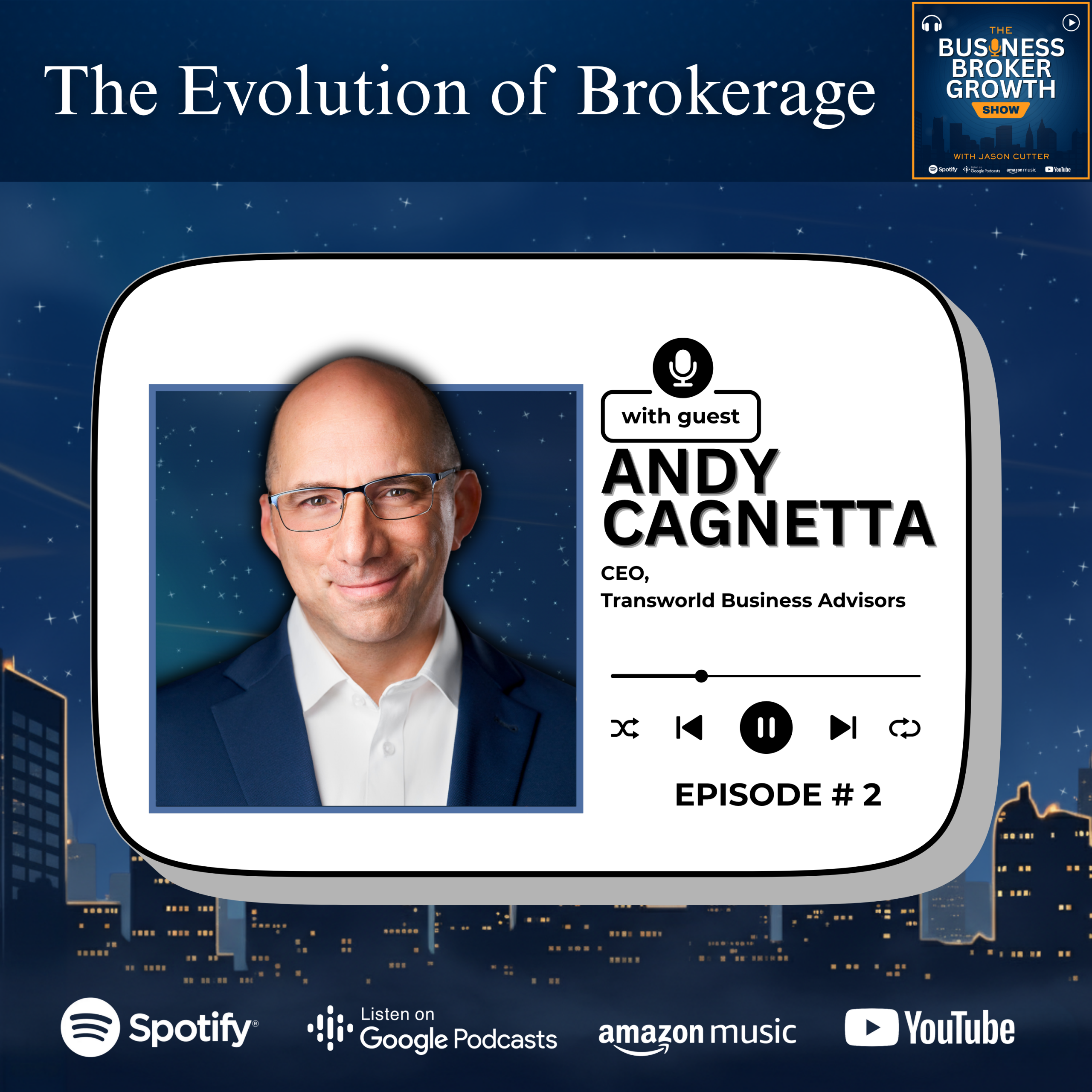
The Evolution of Brokerage with Andy Cagnetta

Episode 2 November 10, 2025 00:54:30
The Evolution of Brokerage with Andy Cagnetta
Business Broker Growth Show
The Evolution of Brokerage with Andy Cagnetta

Nov 10 2025 | 00:54:30

/

Show Notes

Are you still relying on luck and outdated tactics to win listings, or are you intentionally building the kind of trust that makes business owners seek you out?
When was the last time you challenged yourself to move from being a transaction-focused broker to a trusted advisor who’s known for clarity, confidence, and genuine care?

The truth is, sustainable growth and credibility in this industry don’t come from shortcuts or quick wins—they’re built through consistent community engagement, continuous education, and a sincere desire to help. The brokers who rise above the noise aren’t chasing leads or hiding behind automation; they’re investing in relationships, showing up with value, and becoming the voice of integrity in their market.

In this episode, Jason Cutter sits down with Andy Cagnetta, CEO of Transworld Business Advisors, to explore his journey from a new broker to an industry leader who helped shape one of the world’s largest business brokerage networks. Andy shares how Transworld has transformed the industry through professional standards, technology adoption, and collaboration—along with the hard lessons, missed deals, and practical marketing strategies that helped him grow. From redefining “the numbers game” to leveraging AI and authentic outreach, Andy offers a roadmap for brokers ready to build trust that lasts.

Subscribe to the Business Broker Growth Show for more actionable insights on building your pipeline the right way—and share this episode with another broker who’s ready to stop hoping for deals and start engineering deal flow through trust, education, and authentic persuasion.

Guest Links

LinkedIn: https://www.linkedin.com/in/acagnetta/
Email: [email protected]
Website: https://www.tworld.com/

View Transcript

Jason Cutter [00:00:02]:

On today’s episode, I have Andy Cagnetta. He is the CEO at Transworld Business Advisors, the world’s leading business brokerage firm. Andy, welcome to the Business Broker Growth Show.

Andy Cagnetta [00:00:16]:

I’m so happy to be here.

Jason Cutter [00:00:19]:

This is going to be fun. And a little bit of the info for anyone who doesn’t happen to know who you are, doesn’t happen to know Transworld. You have over 30 years experience. You’ve overseen thousands of successful business sales transactions. You turned your business into a franchise model with so many people around the world, 400 brokers, 200 plus franchises doing billion dollars in annual deal volume. You do so much in the community. You have your annual feed that you do to support. You have your pasta dinner for the LifeNet for families where you’ve raised tons of money over what, like the last 20 years.

Jason Cutter [00:01:02]:

And so I’m super excited for you to be here because again, you started in Florida in brokerage, kind of created a lot of these things and then grew it to what it is. And so for the people who don’t know who you are, why don’t you share, you know, kind of how that started and the evolution, how you got here?

Andy Cagnetta [00:01:22]:

Yeah, well, I came to Florida as a buyer. I came to come down the buy business. I had bought and sold a small business up in Connecticut. I bought it for 45,000. Two years later, me and my cousins sold it for 65. So I thought I was a genius and I came down to Florida. My wife grew up down here and so she demanded we move down, which wasn’t too hard after it snows a few times up north. So we moved to Florida.

Andy Cagnetta [00:01:49]:

And I never knew what a business broker was. I never had met one before. I had sold my business by myself up in Florida, up in Connecticut, because I just didn’t realize it. The service existed until I came to Florida. And there was a lot of business brokers down here and I felt like I was in a used car sales room with most of them until I went to transworld. And transworld was owned by a fabulous couple. Donna Bonnie Parish. They welcomed me in.

Andy Cagnetta [00:02:18]:

They basically sat me down and said, you don’t know what you want, you don’t know what you know, and you don’t know Florida at all, which is all true. They said, why don’t you join us and you’ll get the lay of land and you’ll decide what you want to do. And I thought that was a really good idea. And they said, we think you’d be good at this. So I came to Transworld in 95 and I started, I sold nine businesses my first year. And so I, I, I really love this business. I never considered myself a good salesman. I think I’m more of a project manager.

Andy Cagnetta [00:02:51]:

I try to help people do what they want to do. I’m not good at convincing people to do something they don’t want to do. So two years into it, Don’s full retirement kicked in at IBM and so he wanted to sell. I bought the company in 97 and we started growing it. We were about six people at the time. We grew it to 10 offices in Florida, which we still own and operate. And we do about 400 deals here in Florida. And then we grew it.

Andy Cagnetta [00:03:21]:

Then we decided, hey, how do we get to Charlotte? How do we get to Atlanta? And we looked into franchising and as a model and as a industry, we knew nothing about it. So we realized, and I talk about this all the time, that out there in the world, eventually if you want to grow a big business, you’re going to need partners. And, and so we decided to partner with United Franchise Group, who most famously owns Signorama, several other brands. And we partnered with them. Fifteen years ago my partner Ray and I got together and we’ve built Transworld to 250 offices, many countries around the world, over a thousand associates, and it’s been a journey. Wow.

Jason Cutter [00:04:06]:

So there’s some things that you said which I think is interesting is the first one you said that you didn’t even know what business broker was. You just bought, you had your business, then you sold it until you came to Florida. How often do you think that is the case with business owners who don’t even know that there’s a thing called a business broker M and a advisor, intermediary.

Andy Cagnetta [00:04:30]:

Yeah, I still think the majority of people don’t know what it is, even business owners. Now I’ll say in some places where business brokerage has become quote unquote, very popular and Florida being kind of like the belly of the beast, but Texas and other places, I think many business owners know what a business broker is, but they just don’t understand the service. And if I had to speculate, and again, out of 100% of the businesses out there in the world, I think it’s a wild over exaggeration to think that 25% of them are handled by business brokers. That means 75% of businesses that either close, sell, transfer, do it without a business broker. So I don’t think we have market penetration yet.

Jason Cutter [00:05:23]:

And you think that 25% is an overestimation. You think that’s high?

Andy Cagnetta [00:05:27]:

I think it’s an overestimation. You know, in Florida that may be the case because, again, we’re very well organized. In Florida, we have been for, you know, basically 50 years, but it’s still very underutilized service.

Jason Cutter [00:05:47]:

Well, and it’s interesting, and the reason I ask, and it stands out is that every business broker I’ve spoken with always makes a comment about when they go to an event or networking or conference or trade show or anything like that, or at a party, at a barbecue, nobody knows what they do or that it even existed.

Andy Cagnetta [00:06:09]:

Right.

Jason Cutter [00:06:09]:

And so I just wonder how much that awareness and education is missing out there.

Andy Cagnetta [00:06:15]:

It is, and that’s why things like this are so important. I mean, getting out there and helping business owners understand. You know, I sold my business in Connecticut. Again. I sold it for $65,000. I was probably making about $50,000 a year now, if anybody. All the business brokers are out there growing and going. You just undersold it probably by at least one times, if not two.

Andy Cagnetta [00:06:42]:

I, you know, like, you know, so, yeah, I didn’t do a good job of selling my own business. Yeah.

Jason Cutter [00:06:49]:

And. And, you know, when we look at the. The correlations and we won’t go down this rabbit hole, but, you know, people who try to sell their own house or try to sell something and, you know, they think they understand what they’re doing, but they don’t. And then the business brokerage world, selling a business is so much more complicated. It’s not like selling a used car where you could just go online and look at the value because every business is so different.

Andy Cagnetta [00:07:11]:

A lot of times you only have one shot to really do it right. And it’s tough to do it yourself because you could literally, and we’ve seen it before, ruin people ruin their own business by not paying attention during the sale process.

Jason Cutter [00:07:27]:

Yeah. There’s so much to it. Now, the other. The second thing that you said that was interesting is that you came down to Florida, you found out what business brokers were, and it felt very used car sales person.

Andy Cagnetta [00:07:40]:

What.

Jason Cutter [00:07:40]:

What was leading to that or, you know, why did it feel that way? Was it just a bunch of people who are just trying to, you know, make money? Like.

Andy Cagnetta [00:07:49]:

Yeah. I mean, you know, some of the brokers I ran into, which I eventually, probably most of them, I became friendly with later on in life as they, you know, grow, grew older. But, you know, they were very, you know, back then, there Was, you know, business records were not kept well. And I think that has changed over time. And you know, it was sort of a high pressure kind of like, hey kid, buy it or leave me alone kind of thing. And there was really no empathy whatsoever that I didn’t know what I was doing as a, as a business buyer. So, so it just felt very impersonal. You know, I think back to some of those brokers.

Andy Cagnetta [00:08:36]:

Some of them weren’t dressed nicely. I mean, they’re in shorts and Hawaiian shirts. And you know, I showed up at Transworld and Don, being from IBM required shirts and ties. I mean, and probably that didn’t go away here until almost right before the pandemic. And the pandemic just killed, killed the Thai world. But, but you know, we, we were always, you know, had pride in what we did and wanted to be seen as professionals. So.

Jason Cutter [00:09:05]:

And, and you got to wonder too because of the, you know, used car sales like picture. Whenever you say that, when everyone, anyone says that in the salesforce, like everyone can just imagine a picture of that, you know, plaid suit or maybe short Hawaiian shirt, shorts and wide shirt is where that was more prevalent pre Internet, pre information age where people could be more informed, had, you know, the feeling of more selection. Right now somebody could pick and has a lot more, you know, options out there or the illusion of options versus before where it was like you met a business broker, that’s all you thought you could get and then they could just do and treat you however they wanted. Right. Yeah.

Andy Cagnetta [00:09:46]:

I mean, you know, back, back in the day looking for businesses was looking at the want ads in the Sunday newspaper. Maybe during the week there were some ads, but most of it was Sunday. And so you were picking that, that was quote unquote, the inventory you were looking at. And you didn’t know if there was other inventory. Which I quickly realized. That’s why I visited so many business brokers that these guys didn’t know each other’s listings very well. Again, that’s changed over the years. And the ability to find a business for sale required you to buy the Sunday paper, which I used to buy several Sunday papers to try to figure out something that was local.

Andy Cagnetta [00:10:27]:

To me, it was an interesting time. I mean, Biz Buy Sell and any of the websites that you can go to for business brokers usually has the inventory on there. So yes, you have lots of choices and lots of information out there and, and, and just things like comps are available now. It’s just, it’s a way different market.

Jason Cutter [00:10:50]:

Yeah. So let’s talk about. Because one of the things when you and I spoke before getting on here is you were talking about the old school mode where you know, selling brokers don’t accept a buying broker don’t want to, you know, share commissions. And then how that evolution became a thing and then became required. You know, kind of what you saw as that taking place in Florida. I think it’s, I think it’s really important because I think there’s you know, a lot of value in essentially opening up the, the market to so essentially buyer’s brokers. Right. Buyer’s agents coming in.

Jason Cutter [00:11:30]:

Yeah.

Andy Cagnetta [00:11:30]:

I’ll tell you a few things. Number one, you’re stepping on the third rail of business brokerage. Right.

Jason Cutter [00:11:35]:

Let’s do it. Let’s do it.

Andy Cagnetta [00:11:36]:

So, you know, I feel very strongly about co brokerage. I think there needs to be an open marketplace, by the way, so I’ll cover that in a second. But so in Florida, since the 80s, 1980s, for almost 50 years now, we have had a mandatory co brokerage organization where we co broke with and listen, it’s not perfect. Do people not respond because they have other buyers and stuff like that. All kinds of shenanigans might go on but for the most part we co broker here in Florida. We sell $1 billion of businesses in Florida almost every year. We I, the number of transactions probably in the thousands have pale in comparison to anything else that’s out there in the world. Any local organization.

Andy Cagnetta [00:12:35]:

Texas, you could, I mean you could. I’m not picking on Texas, I’m not picking on Colorado, California, but they don’t co broker, they don’t. And their MLS has very few listings on it. And therefore buyers do have to go to different brokerages to try to find what they want or need. And it’s a very inefficient system. And as the taxi drivers found out, who had the exclusive at airports and didn’t need to make it easier to call a cab, didn’t make it nicer inside the cabs, didn’t need to make it easier to pay. They found out what happens when technology and the consumer demands choice and demands ease of purchase. And that is what’s going to happen.

Andy Cagnetta [00:13:28]:

It’s not if, it’s when. And business brokers have a chance. Mark my words out there, business brokers, you have the choice to be part of that or be run over.

Jason Cutter [00:13:42]:

And, and I can totally see that. Right. I think that the taxi analogy is perfect. I think everyone by now has experienced the ease and convenience and, and peace of mind that comes with, let’s say, something like Uber or Lyft, where I know what I’m paying, I know I’m going to get there, I know I’m not going to get routed the long way around and taken for my money and you know, whatever. Like I know and I know there’s a way to complain if I, if it’s not good. And I think that’s like you said, for brokers to understand that. And then I think the thing too that’s part of this, that I know from reading your book, which we’ll talk about at the end, is that also if the ease of finding them, the MLS system is not there and it’s not listed, then you’re not getting as many buyers, which means you’re also not doing the best thing for those sellers. Like the sellers not having the right supply and demand probably and missing out on even more of a sales price.

Andy Cagnetta [00:14:38]:

Yes, but that is changing. And you know, Biz by sell axial, other platforms have made it possible for buyers to find the inventory. Now it’s just perhaps more inefficient than in Florida that they might have to deal with multiple brokers. And again, okay, that’s getting easier too because you know, you don’t have to call someone and get faxes and you know, try to sign NDAs. All this stuff can happen automatically now. Now sims get sent out. Meetings with sellers can happen via Zoom. It’s gotten much more efficient.

Andy Cagnetta [00:15:16]:

So I’m not jumping up and down saying hey, we’re missing out on co brokerage because co brokerage actually our statistics have come down. So we used to co broke more than we used to. And I think again that’s a function of the databases that we now all maintain. The Axial or Transworld or even Sunbelt or Murphy, we all have buyer databases and Biz by sell as well. And we all have buyer databases where we can immediately send out notices that we have this new listing for sale and there’s so many buyers now this may change when the buyer activity kind of calms down a little bit. But right now there are so many buyers that you know, we could put out. We put out a large plumbing electrical Service, we got 220 something NDAs. Within the first couple weeks we had half a dozen or more meetings with the right sellers and we had multiple offers for our seller to choose from and that was all within a couple weeks.

Andy Cagnetta [00:16:21]:

We just listed a diner yesterday, last week that we have a full price in terms offer from a billionaire in it out that’s coming from out of the country. I mean, the activity is so hot that the market is efficient despite itself.

Jason Cutter [00:16:44]:

That makes sense. And so with all of that, then where are brokers still struggling? I know we’re going to get into the rapid fire marketing playbooks. I know you have some tips to share, but where are brokers still struggling in this kind of a market?

Andy Cagnetta [00:17:03]:

Yeah, well, so the hard part for brokers, and it’s getting harder out there is to harness all the data and continue to maintain a digital presence and harness all the things like AI. So that itself has become a job. And you know, again, I think that’s one of the, one of the benefits of joining someone like Transworld is, you know, we’re working on that every single day. So you don’t have to, your job is to go out in the community, find the deals, get the deals done. Our job is to worry about the, the AI and the data and negotiating with the platforms and insurances and, and making sure our website and our social media programs are doing well. And you know, all that stuff is just noise. I mean, running the business of a brokerage is become more difficult year after year and more expensive. So I think you’ll continue to see consolidation out there in the world of brokers.

Andy Cagnetta [00:18:09]:

But you know, people still come in as independents, which is all good, but because there’s room, there’s still room out there, as we said before, if all the baby boomers are to come to the marketplace, actually scares me that there’s not enough of us.

Jason Cutter [00:18:24]:

Yeah, yeah. Because there’s, there’s going to be a ton of those businesses that, you know, I think more and more from what I hear, and businesses that I’ve spoken with directly myself, where they know the future, the generation, the next generation doesn’t want it or they don’t want to give it to them. And so the exit is the best way. Right. And how do they exit with that legacy intact and get compensated for that and instead of just shutting it down or losing debt?

Andy Cagnetta [00:18:53]:

Yeah, the marketplace is good right now and I want to make buyers and sellers feel good about one thing. And I think this is interesting, right? I don’t think businesses sell that are overpriced. Right. So I always tell buyers, listen, it’s wildly competitive to buy a business, but you still don’t have to overpay. Which is a, I think it’s a unique thing in our business. You know, you think about real estate, if you want to be in a certain neighborhood, the prices jump up and you’re going to have to overpay. You’re going to have to pay more than listing price. You know, with things like the SBA here in the United States, you’re not going to be able to overpay because the SBA is not going to let you.

Andy Cagnetta [00:19:40]:

And because there are valuation methodologies that are pretty well established and data out there that kind of brings all businesses into some sort of a zone. Now, I always tell Pete, buyers, listen, you’re going to have to pay, quote, unquote, top dollar, but you’re not going to have to overpay. And really, buying a business is still such a bargain. Or as far as an investment is concerned, I think buyers can still feel good about going out there and buying businesses.

Jason Cutter [00:20:12]:

Yeah. And, and what if you had to say, or gas. And, you know, I know you’re not in every transaction that transworld does, but, you know, you get a good sense of it and I know you do a lot of speaking and you have your own podcast. Is how much of that where buyers are not going to overpay, they’re going to pay the reasonable right amount. Right. Let’s say the market price. And then getting something where there’s a ton of potential because of those baby boomers who aren’t, you know, implementing technology, don’t have process. Been doing the same thing for 30 years.

Jason Cutter [00:20:46]:

Have vendors on handshake agreements, like, what. What percentage do you think that that opportunity is there versus businesses where it’s running? Well, you’re getting it. Just don’t screw it up.

Andy Cagnetta [00:20:57]:

Yeah, it’s a little both. Right. So I always tell people, listen, if you’re going to go into a business, try not to do anything major in the first six months. Like, you know, don’t change the food on the menu, don’t change the signs, don’t change. You know, don’t do anything to tip the world off that this is no longer the same owner or the same business, because that’s what you bought, right? You bought this goodwill. You know, you don’t know what is driving the goodwill. It could be the fact that this restaurant you bought looks like a greasy spoon and people love it because of the nostalgia. And all of a sudden, you’re going to come in there and modernize it and kill it, right? So, so be careful of that.

Andy Cagnetta [00:21:40]:

But then all those opportunities that you have, like, so we just sold a very famous restaurant here in Fort Lauderdale called Hot Dog Heaven. Been around. Guy ran it like was the 1980s hysterical. I mean, old cash register, cash only, no doordash whatsoever. You know the place certainly looked like a greasy spoon. But he didn’t care. Right. He’d been running it for 40 plus years.

Andy Cagnetta [00:22:05]:

So we sold it to a guy. POS system cleaned up the place. New grease trap. New digital menus. Doordash sales are up almost two times. Two times. So the end. But kept the employees, kept the same menu, kept the same prices.

Andy Cagnetta [00:22:25]:

Which was hard. Right. You know but now starting to edge. Edge them up. Doordash you can make a little bit more money. So those kind of things. There’s tons of opportunities out there for everybody who buys a business. You know, just be careful what you do when you go in.

Jason Cutter [00:22:41]:

Yeah, I think that’s great And I love that advice that the six month rule. Just don’t change anything.

Andy Cagnetta [00:22:47]:

Nothing.

Jason Cutter [00:22:47]:

Nothing dramatic. Improve things that you know most customers aren’t going to.

Andy Cagnetta [00:22:51]:

Yeah sure.

Jason Cutter [00:22:52]:

And find more convenient than the way it was always done. But don’t change things. Yeah.

Andy Cagnetta [00:22:58]:

You’re going to have to prove yourself anyway to your customers. We bought our pasta shop in Hartford from two little old ladies. You know, 70 year old ladies. And now there’s these two 20 year old kids running this thing. No matter. We didn’t change the recipes, we didn’t change the way we cooked, we didn’t change anything. But as far as the old guard who used to come there, the recipes changed, the food tasted different and it didn’t. I mean we know so but you know we had to go out there and get our own following.

Andy Cagnetta [00:23:29]:

So you’re going to have to do a little of that as well.

Jason Cutter [00:23:32]:

Now one thing that you mentioned was that the broker is business broker in the transaction is managing and handling a lot of different things. You touched briefly on AI which we’ll talk about in a little bit but how they’re just managing lots of stuff and the tools, the technology, all the partners. In your book you have a chapter talking about the business broker being a quarterback on the team. And I wonder because what made me think about it is with tools and the technology and many brokers being left behind or. Or not being a very good quarterback. They’re a quarterback when the game used to be simple and there maybe with less players involved, you know, one cpa, one attorney and. And how much is it grown? How complex is it now and how is it like if you want to be an NFL super bowl team, you know in a quarterback that’s leading that it’s completely different than high school quarterback. Right.

Jason Cutter [00:24:29]:

And playing the game.

Andy Cagnetta [00:24:30]:

Yeah, I guess things have somewhat changed. But I think as a business broker, the successful ones have the ability to manage issues. Right? That’s, you know, why do deals not close? Number one thing is unrealistic expectations. And whether that’s unreal expectations of the landlord of the bank, of the, of the attorneys, of the accountants, of the buyer, of the seller, of their spouses. It could be a myriad of people. The business broker as the quarterback has to recognize and call the play. And if there’s something wrong, you know, and I’m managing a deal right now, which is a long story, but I’m managing a deal for a friend of mine who’s, you know, they’ve been my friend for 20 plus years. And, you know, and I just like, asked for the lease yesterday, you know, and they’ve been in the same location for 20 years, and there’s nine lease addendums.

Andy Cagnetta [00:25:31]:

So the bank wants the paperwork, right?

Jason Cutter [00:25:34]:

Yeah.

Andy Cagnetta [00:25:34]:

So they sent over this blank lease. This is the original lease. I’m like, that’s not what the bank’s looking for. The bank needs the paper trail to now. And, you know, the email back I get is, this is ridiculous. This is so complicated. I’m not doing that. And I have to call up and manage that and say, yes, you are, if you want to get to a closing.

Andy Cagnetta [00:25:57]:

But having that quarterback, being able to quarterback those emotions, those expectations, and being able to change them is what makes a successful business broker. And it’s about building that trust and it’s about building that, you know, reputation out there as, as an expert in, in buying and selling businesses.

Jason Cutter [00:26:21]:

How much of that comes with both experience in the world, experience as a business broker, and a mindset to also be able to predict the future, going along with setting the expectations and knowing, like, if, if I need this, I’m going to need all of it and kind of, you know, seeing around corners so you can always stay ahead of it.

Andy Cagnetta [00:26:40]:

Yeah, seeing around corners is important. I think. It’s. You have to set the expectations, right? So, you know, like, I, I’ll tell people, a seller, that, you know, going through the SBA process with a buyer is going to be exhausting, and you’re going to be like, I can’t believe I have to give one more piece of document. And so just when you thought you didn’t have to give more documents, you’re gonna have to give more documents. So I try to set that expectation in the beginning to tell buyers and sellers. And that’s part of, you know, why we want to work with known quantities. That’s why you Know, we talked about earlier getting the right team together and stuff.

Andy Cagnetta [00:27:17]:

And that’s, I talk about it in my book as well, having known quantities. And NFL coaches talk about that all the time. You know, they have a couple superstars that are head cases, they got a couple new draft picks that are wild cards, and they’re trying to figure it out, but they have this stable of players, players that they know are going to show up to practice, that they know what they can expect from them. And it’s not, they’re not flashy guys. They’re the guys that are going to. And that’s what, you know, you need to do as a business broker. You’re taking the attorney that you’ve closed lots of deals with. You’re going to the SBA bank that you know how to deal with them, and you could talk to the underwriters if there’s something wrong.

Andy Cagnetta [00:27:53]:

You know, you’re going to the CPAs that you’re know how going to run the QE of qov, because you’re trying to take out those, you’re trying to take out the variables, you know, the, the nightmares that are going to happen in a deal because it is complicated.

Jason Cutter [00:28:09]:

Yeah. And, and some of it is, is knowing the partners in the transaction, the known entities, the ones you can trust, and also the ones where you’ve built up enough of relationship and professional credibility, where, you know, analogy could be there’s beans in the jar. And so there’s enough beans in the jar when you need help or you need a favor or you need something done. You know, there’s, there’s that relationship that’s been built over time that can then facilitate it. Like you said, when things go sideways, when something comes, it’s not if it’s, it’s when in the kind of transactions. And then one last question before we get into the next segment, because I’m curious because you said you found that you’re a better project manager than a salesperson persuader. And you, you put yourself in the project manager bucket. Yet funny enough, as you just said that you’re, you’re managing a transaction which is project manager.

Jason Cutter [00:29:01]:

Like, once you get it now, the rest is, although you could always argue that everything in life is sales, so you’re always selling, even through the transaction, for, for you, where has, where did that make you a successful broker on the project manager side more than sales, where do you see, you know, brokers needing to be the blend of both, you know, and maybe which is stronger, which is better? And then, you know, you can answer all this at once, which is then also like now you’re running this and you evolved into running things very quickly. Is that, are you more of that, that business runner versus the business broker mode? And where do you see others that are kind of fit for one or the other?

Andy Cagnetta [00:29:45]:

Yeah, it’s interesting. I see with my own franchisees too, like I’ll tackle the last part first, that there are people that are good doing deals and by the way, I don’t think I’m great at doing deals. So I have people here that are way better than me and then there are people that are good at running businesses. And a lot of times the two don’t mix. And so I’ve been way more successful as a business runner, as a business. As I always tell people, my job is to provide my brokers the tools to succeed. So I’m forever chasing things like technology and chasing things like processing, chasing things like marketing to make it easier for them to do their jobs. And you know, I’m there as a tool for them if, you know, needed in an emergency.

Andy Cagnetta [00:30:38]:

And that’s part of building a community too. As far as being a, you know, a good business broker and, and being a good deal maker. As far as, you know, you, you talked about some of the traits, you know, I think empathy is huge. I think being genuine and being tr, you know, trustworthy because, you know, first of all, it’s a small world. It, you know, out here in the business brokerage world. So I’m always, you know, I, I think if you talk to any of my competitors, I would hope that 90 something percent of them don’t have anything bad to say about me and in fact would tell them that I’ve supported their careers as well because I think it’s a small little business. Brokerage world, number two is as far as out there in your community of buying, selling businesses, you’re not going to do well by selling someone a business that doesn’t fit them or that they shouldn’t buy. So we’ve been, you know, known to step in and say, you know, this is not the right deal anymore.

Andy Cagnetta [00:31:43]:

Everybody needs to go home, including the buyer. And you know, I learned that early on from almost buying the wrong business down here in Florida where somebody reached out to me and said, you’re not seeing everything. And I like you and your wife, you’re, you’re two nice people and I don’t want you to see it again, see you get in a bad situation. So I was kind of saved in the beginning And I want to, you know, I want to make sure that I’m doing that now. I’ve long ago stopped trying to predict who would do well in business. So I don’t try to do that because I don’t. And I don’t know what everybody wants or needs. Like, would I buy a wave running business on the, on the ocean and rent wave runners all day? No, not my thing.

Andy Cagnetta [00:32:27]:

But it might be for that guy. And I watched someone who I completely underestimated would do well in that business and they went in and opened 10 locations and did wildly well. So who am I, right?

Jason Cutter [00:32:41]:

You never know. You never know. But that’s, that’s great. All right, let’s get into the broker growth playbook rapid fire section. So this is the part here for listeners tuning in where I want you, Andy, to share some of the tips, some of the rapid fire things that will help business brokers grow their business, Right? Some it could be marketing, some it could be technology. Things that you’ve learned over all the years that you’ve done this. And what’s fascinating, and I love about you too, is your perspective. It’s not just because you’ve been in the business a long time.

Jason Cutter [00:33:14]:

It’s because you’ve also seen a ton of brokers, right? And you’ve seen a ton of models in a ton of locations. Because what works in Seattle might not work in Ohio might not, you know, but you’ve seen it all. So when you’re ready, let’s start with the tips that come to mind as you think about this. What have you got for number one?

Andy Cagnetta [00:33:34]:

Number one is this is still a numbers game. If you’re going to be a successful broker, you have to get out there. And if you’re going to rely 100% on technology, it’s probably not going to work for you. You have to get out there in the world and be a, be present because you need to touch as many people. Now, you can use technology to touch thousands of people, but at the end of the day, you’re gonna have to go out and meet them. And really, you know, if you’re not gonna build your own community, you have to build your own community because people are gonna check up on you and they’re gonna call their accountants and they’re gonna call their attorneys and they’re gonna check up on you and they’re gonna look at LinkedIn. So again, it’s not just, it’s a numbers game. You have to get out there.

Jason Cutter [00:34:25]:

Got it. And get out there. Numbers game. Grow the community. So not the numbers game, as in, like, I need to send 10,000 emails a month to every business in my area, but a numbers community, relationship building, shaking hands and kissing babies. And not just for the sake of biz Dev, but also what I hear you saying is if is for relationships and also validation. When somebody says, hey, do you know, have you ever, have you ever met Andy? What do you think of Andy? He, he wants to help me sell my business.

Andy Cagnetta [00:34:55]:

You have to become a trusted advisor. And there are ways to do that out there in the community. And it’s giving back first. You know, that’s my other tip. You know, you want to go out there and give back.

Jason Cutter [00:35:07]:

Let’s talk about that. So is, is getting out there and giving back in, in what mode? And again, I, I know you well.

Andy Cagnetta [00:35:15]:

Enough, even though I don’t know you.

Jason Cutter [00:35:16]:

Very well, as I know you well enough to know that it’s not the give to get strategy, which is if I give and I do stuff in the community, I’m going to get things. And so where is that, where’s that mode for you? Where is the heart for you as a tip? Yeah, you know, I, I, I, I.

Andy Cagnetta [00:35:30]:

Started my philanthropic career just because I wanted to help someone. I think, you know, a lot of times business brokers, that what we’re in the business to do. We’re here to help people who want to do something. They want to buy business, they want to sell a business. We’re going to get that done for you. So when I met, you know, someone from the LifeNet for Families, which was the feeding program at the time, and they had a bad air conditioner and they, you know, she was cry, literally crying at lunch when we were having lunch together at a networking group, by the way, getting out there, numbers game. So I piped up and I said, I’ll help you. And she’s like, how are you going to help me? I’m like, I don’t know.

Andy Cagnetta [00:36:09]:

We sold some air conditioner companies. I’ll twist one of their arms because now I’m friends with them. I’m going to stay in touch with them. We’re going to get a new air conditioner for your charity. And we did. And I got to be on a board of directors and, you know, eventually became chairman and eventually told everybody on the board, we have to do something to raise money, and started my pasta dinner. But, you know, and I didn’t do that to get out there. I did it because we needed money at the charity.

Andy Cagnetta [00:36:37]:

And this was a Means to an end. And. But everything that it has brought to us, you know, we started with a few people. We started with about 30 people coming to that dinner. We raised, I think, $500. And, you know, the last few dinners have had a thousand people. We’ve raised over $300,000 each time. And it’s, you know, and just everything that has come from that, all that, you know, all the interviews on with television stations, all the being asked to be on the United Way Board, Junior Achievement Board, the 100 CEOs of Broward county, all that came because I was taking a leadership position in the community.

Jason Cutter [00:37:21]:

Yeah. And I think the key underlying part is going back to something very early on we talked about, which is the used car mode, is that people can generally tell if you’re not being authentic in the giving, if your intentions are different, if you’re going to networking meetings and your intentions are just to scoop up all the referrals you can and then go on and move on versus long term relationship, Planting seeds and playing the long game. And I love that. Right. Like, I think that’s so important to do that. And then it facilitates the numbers game. But in a very authentic long game, let me just, just help and be present. And how do you do more of that? Right.

Andy Cagnetta [00:37:59]:

Yep.

Jason Cutter [00:38:00]:

Okay.

Andy Cagnetta [00:38:02]:

Do you have a third one?

Jason Cutter [00:38:03]:

A third tip, A third hack for business brokers?

Andy Cagnetta [00:38:08]:

Yeah, it’s all about marketing, you know, like, and there’s no. My third tip is there’s no one good way to market yourself. I mean, there’s good ways, cheap ways, you know, like everybody going out and putting notes on doors or shaking hands or go, you know, going out the networking. But you have to understand that to build a business, you have to advertise and you have to spend money on advertising. And I think that people always ask me, why have you been successful? Others haven’t. It’s like, because I’m not a brokerage. I, you know, I’m a business. We’re a business and we have to advertise and we have to tell people about our services.

Andy Cagnetta [00:38:54]:

And there’s no one good way to do that. I always tell people, we could buy a Super bowl commercial. We spend 10 million bucks. You know, it’ll work. We’ll get plenty of leads. The only question is, will we get our 10 million bucks back? The answer is probably no, because that’s probably not the most efficient way for us to go out there to the marketplace. But there are better efficient ways, even for agents, if you don’t think you’re in your own little business. You are.

Andy Cagnetta [00:39:23]:

And the beautiful thing is that there are now opportunities for you to advertise that don’t really cost anything. I mean there’s cost, you know, but for you to have a YouTube channel, for you to do podcasts, for you to have an Instagram, for you to have a Facebook page, you don’t have to advertise. You could probably get better numbers and go out there and tweet the numbers game by buying advertising on those platforms. But you could really kind of do it on a ground level. So, you know, you gotta advertise.

Jason Cutter [00:39:59]:

Yeah. And I love it too because one of the things you said that really stuck with me and I’ve been around sales and marketing for a really long time and marketing to drive leads and interest for sales teams. Right. So not just branding, like let’s just run commercials, but performance based marketing. And one of the things you said was everything works in marketing. The question is, will you get your money back? Going back to your, your super bowl commercial, you could do it, but will you get your money back? And so everything works if you play the long game and depending on the ROI you need and, and it’s so true. And I think the biggest thing with all of that is, is what is, what is what resonates the most marketing wise with somebody, what can they get behind and then continue on and do. And then here’s the big thing and I don’t know what advice you have for this is where marketing falls off the map.

Jason Cutter [00:40:48]:

When a broker gets busy in a, or multiple transactions and they stop planting seeds and then next thing you know those transaction transactions are done and their farm is, is void of crops and, and then now they’re in this feast and famine mode.

Andy Cagnetta [00:41:02]:

That’s why it’s hard to do it by yourself. You really need partners. And so you know, joining a franchise or joining a brokerage is helpful in that because they’ll keep marketing for you. That’s why I always tell people who join Transworld, like let us help you. Let us, you know, leverage all the things that we’re giving you. Now if you’re by yourself, that’s okay too. You just have to buy the advertising. You have to pay someone.

Andy Cagnetta [00:41:28]:

To be your social media manager, you have to pay someone. And there’s plenty of ways to do that these days. You know, God bless the Internet, fiverr and upwork and all the ways that you can hire people on a contract basis to go do things for you. So, but again, and, but, and you got to Decide what you want in your life, right? So I have three octogenarians that work for me, 80 plus year olds. They’re here to enjoy this business. They want to have purpose. They want to do three, four deals a year maximum. They want to take care of their clients and get deals done for them and use their expertise.

Andy Cagnetta [00:42:08]:

They’re not looking like some of my young guys to do 20 or 30 deals a year and make themselves a million dollars. That’s not their gig, you know, so you have to decide where you are in your life as a broker and what your plan’s going to be to build that life. Because some people are like, hey, I have some, you know, I have some people that want to continue to be a part of their family and you know, and, and, and, and be a provider. You know, Mike Shea was one of those people. His wife works in a hospital when she’s gone out of work, she’s not picking up the kids and she’s not driving them to practice. And you know, and he did that. Now he chose that he was going to work at night and get things done and be able to balance those two things. But you got to decide what you want and then, you know, put the plan together to get it.

Jason Cutter [00:42:58]:

I love it. I think that’s great. All right, so let’s shift. This segment is really fun too. And, and I know we spoke about it. I think you have some good stories to share. But let’s talk about the one that gone away. If we talk about the lessons from a lost deal, which I’m sure you’ve seen yours and then you’ve seen countless others for other, other brokers.

Jason Cutter [00:43:19]:

And you know, I know that these can be painful and emotional and challenges and you know, financially it sucks. I’ve talked to some brokers who have lost some deals and just really crush them, you know, when their, their pipeline’s falling apart. But I appreciate anything you can share that may help other brokers, you know, lessons that are in there and business owners that are listening too because you know, they’re the ones that are involved in that. So let’s talk about what’s, what’s it, what’s, what’s a deal that got away.

Andy Cagnetta [00:43:47]:

So many deals, so many deals out there in the world. So many deals. But I, I, I’ll, I’ll relay one. We had a hurricane shudder business for sale. Very type A personality running the business. And what we didn’t realize was we don’t, weren’t doing a good job of managing them in the, in the the process. And through the process, we eventually told him that, you know, he was so ingrained and so really, he was everything in the business. He did not use the E myth.

Andy Cagnetta [00:44:19]:

He did not E myth as the business. He was. He was the chief cook and bottle washer, and this was a business that was EBITDA of a million dollars. And he had a wonderful acquirer. We eventually got to talk to that acquirer and said he was just so overwhelming and so demanding in this process that we just decided we didn’t want to work with him. And so we were counseling him to. That he needed to take a step back in his business, which he did. And he wound up hiring a private equity group guy that helped him run his business.

Andy Cagnetta [00:44:55]:

That private equity group guy sold it himself. So we lost that deal out of our own advice. But, you know, we probably should have been more. We should have coached them earlier in the deal about how the. Those buyers were going to expect him because they wanted him to stay and build a company, but how they expected him to interact with them.

Jason Cutter [00:45:19]:

Yeah, yeah. And. And I can imagine where that’s tough. And for that type of personality, I can imagine where, you know, I don’t know how well that advice would have gone. Would it have gone well early on, you think that point in the transaction.

Andy Cagnetta [00:45:34]:

You know, it’s hard. I mean, I always, you know, we have a saying, you want to be the first child, the second spouse, and the third broker. You know, so sometimes it’s about being, you know, these sellers are going to go through an education process, and sometimes that’s with a different broker. And then by the time they get to you, they understand the marketplace, they understand pricing, they understand structure, and they understand their place in the transaction and that they need to use the professionals that we’re going to bring to the table. So, you know, sometimes you’re just not the broker who’s sitting there when all that happens.

Jason Cutter [00:46:13]:

Yeah. And where I can imagine in that, you know, be the first child, the second spouse, and the third broker, which I absolutely love, is, you know, by the time you’re the third broker, you’re no longer the bad guy telling them the things they don’t want to hear. And hopefully it’s sunk in enough where now you’re just the hero who just gets to cross the finish line without all the emotional damage. Yep.

Andy Cagnetta [00:46:36]:

Yeah.

Jason Cutter [00:46:36]:

I love it. Well, I appreciate you sharing that. I think it’s, you know, again, going to the expectations also. I think really understanding personalities and behaviors and people and their types and things like disk and all those kind of attributes that then helps you understand like, what are we going to get done with this person, how do I manage them, how do I coach them, what kind of feedback can I give them? And is it a good fit? Because, you know, in these transactions, these aren’t simple and they’re not quick. And so how much of it is, you’re also picking the seller and the type of person you actually want to help represent versus not. I mean, how many times does that come across where you, you meet a seller and you’re just like, this is not a good fit.

Andy Cagnetta [00:47:21]:

We, you know, one of my brokers says, who’s been with me for over 30 years, he, he says, I try to imagine whether or not that person’s going to be in their chair 12 months from now. And if I can imagine that they’ll do almost anything not to be in that chair, I’ll, I’ll take them at any price. I’ll take them with any preconceived notions that they think they have, because I think I’m going to be able to change them within 12 months. The problem is. Yeah, and that first example that I gave that gentleman was probably about 50 years old when we had that conversation with him. And you know, he was a young, spry entrepreneur. He didn’t need to sell.

Jason Cutter [00:48:02]:

You know, so now he didn’t, he didn’t need to. He wasn’t in that phase of life where he was tired and burnt out and done. He was still charging hard. So. Well, I love it. I appreciate you sharing all that. And before we get into how people can to reach out to you and follow everything that you’re doing, I just want to remind the audience, everyone tuning in, what we do here at Business Broker Growth. It’s interesting, Andy, you were bringing up marketing and things like that, which is what we do.

Jason Cutter [00:48:28]:

We help equip brokers with modern marketing systems that replace guest work with growth. And really our goal is to help them become trusted advisors with the technology and things that you mentioned, which is fascinating and fun and really leaving it so that the, the brokers out there can do what they do best, which is build relationships, help owners sell their businesses, and close transactions. And so we do that with our done for you programs and with our advising and our services. And so we love to help the brokers out there in the world so that they can do their mission of helping business owners exit. All right, Andy, so last thing before we get into your content info. If you had to give brokers just one Piece of advice to win more listings and referrals, things like that. What would it be?

Andy Cagnetta [00:49:15]:

Get educated. You know, know your business. I think it’s really important. I think when I first started this business I had a full head of hair and I was young, I was, you know, 29 years old and my big fear was that I was not going to be able to walk into a 60 something, 70 something year old business owner and tell them, I’m the guy, I’m your answer. I’m this 29 year old kid at the time. So I was smart enough to go out and you know, as quickly as I could get a CBI from the ibba, I did get my valuation credentials. I’m not sure everybody needs to do that, but I was very, I was very worried about not being able to understand and I didn’t have a huge accounting background. So the valuation credentials definitely helped me learn what to look for on balance sheets, what, you know, how to unwind the ways people were cheating on their, on their taxes and, and be able to talk to people in a way that they thought, you know, that they knew that I knew what I was talking about.

Andy Cagnetta [00:50:23]:

So get educated.

Jason Cutter [00:50:26]:

Got it. I love it. I think that’s so important. It’s funny because early on was in the mortgage business when I was in my 20s, worked with a guy who was younger than me and looked a lot younger. He looked like a teenager and he would literally put on glasses and wear a suit and try to look, you know, older in the mortgage business because he’s like, no, he’s going to take me serious. And then he got to the point where he knew enough stuff and he didn’t care and he had the confidence and he was like, I don’t need to try to look older. I know my stuff. And so I think that’s key.

Jason Cutter [00:50:56]:

I love that. All right, so for people who want to follow you and connect, I know they can go on LinkedIn, they can find you Andy Cagnetta and it’s C A G N E T T A. So if you go to LinkedIn this will all be in the show notes for anyone listening or. But it’s a, it’s a Cagnetta on LinkedIn. Your website obviously is tworld.com and your ac@t world.com if anyone wants to email you. And then you have your YouTube channel which you have. The, the one that I find fun, I love is the At Coffee with Cagnetta. Really like the conversation you had with your brother, which was fascinating and fun.

Jason Cutter [00:51:33]:

Kind of introduction to that, kind of a casual conversation with you. So what else? Any other ways people can find you, Any other things you’re excited about out there that they can find online?

Andy Cagnetta [00:51:45]:

Yeah, no, I mean, those are the things we are going to. We’re working on plans for the next pasta dinner. That was the other deal that got away. But it’s another story for another day for where we used to hold the pasta dinner at a large catering hall that was sold kind of around us that wound up being warehouses now. So we’re looking for a new location, but we’re excited to do that. Andyspastadinner.com so we’ll be probably rolling that out next year and getting back to helping feed people. So.

Jason Cutter [00:52:18]:

Got it. And I mentioned and alluded to it earlier, but your book, Closing the Deal with, which is a great book, focused on helping business owners understanding, you know, as a guide on how to avoid pitfalls and help successfully. It’s also a great book. I enjoyed reading it, thinking about from the broker’s perspective and also managing it as that quarterback.

Andy Cagnetta [00:52:40]:

Right.

Jason Cutter [00:52:40]:

All the lessons you’re giving to the owners there in the book. It’s also great for anyone else that’s facilitating it. So I appreciate you being here, Andy. Thank you for all that you’ve done for the brokerage world. I know that a lot of it is to help lift up and make it a professional organization. Yes, people can get license, get their certificates, but it doesn’t make them professionals. And I think with the kind of stuff that you do and on the franchise model and, you know, holding everyone to that standard, I think it’s, it’s for the best. So I appreciate you being here, Andy, and sharing all this with the Business Broker Growth show audience.

Andy Cagnetta [00:53:13]:

You’re welcome.

Jason Cutter [00:53:15]:

And for everyone else, we appreciate you tuning in. Make sure you follow us on LinkedIn, on YouTube. We have the podcast, obviously, support, subscribe and make sure to turn on the bell icon so that you get notifications when every episode comes out. And until next time, stop hoping for deals and start growing your pipeline.

Other Episodes

Episode 5

November 18, 2025 00:11:25
Episode Cover

Bonus Episode with Andy Cagnetta

What will brokers need to stay relevant by 2030? And if you could wave a magic wand to automate just one marketing strategy, which...

Listen

Episode 1

November 10, 2025 01:05:37
Episode Cover

Real Success in Business Brokerage with Gregory Kovsky

What if an abundance mindset isn’t just about being positive—but about being selective?Are you chasing every listing that comes your way, or intentionally building...

Listen

Episode 3

November 10, 2025 00:42:54
Episode Cover

From Sports Bars to M&A with Dave Long

Are you chasing every listing that comes your way—or choosing clients who truly align with your values?When the pressure builds to close deals, do...

Listen