What if an abundance mindset isn’t just about being positive—but about being selective?
Are you chasing every listing that comes your way, or intentionally building a practice grounded in trust and long-term success?
Moving from a numbers-driven hustle to an abundance-driven approach means redefining what growth looks like. It’s no longer about stacking listings—it’s about deep relationships, quality representation, and credibility that compounds over time. When you focus on serving first, passing on misaligned deals, and mastering your craft, you stop running after volume and start engineering meaningful, sustainable success.
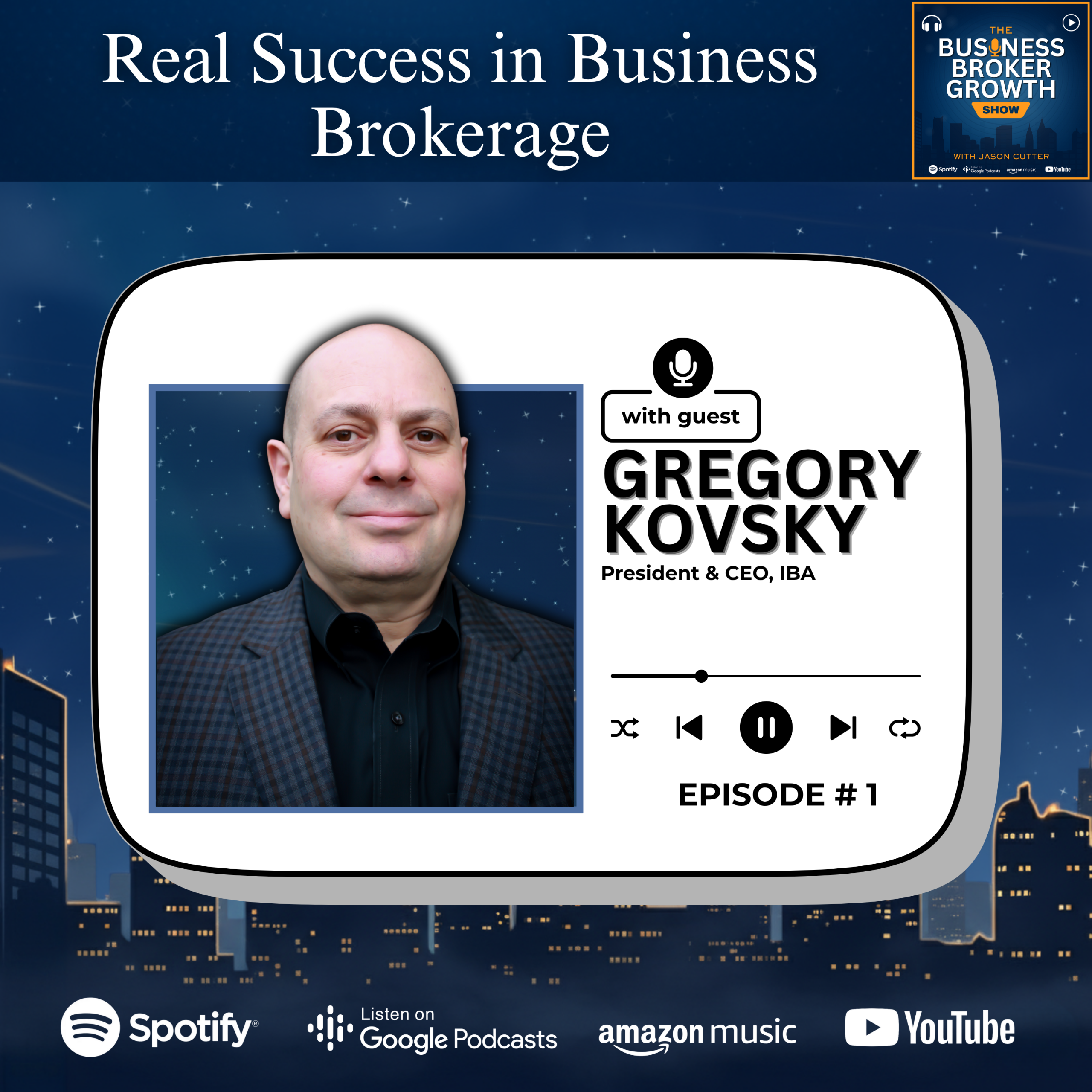
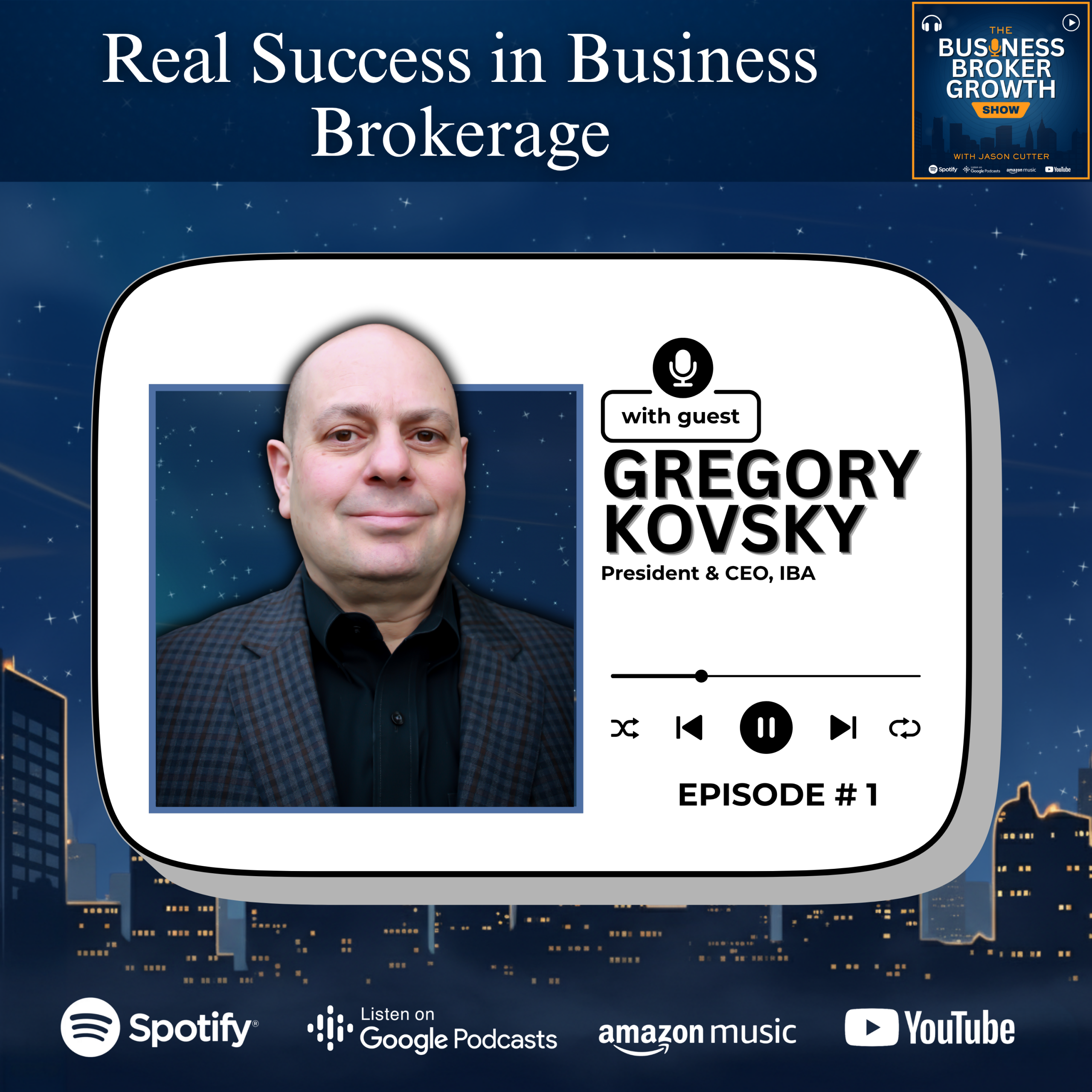
In this episode, host Jason Cutter is joined by Gregory Kovsky, President & CEO of IBA, who shares three decades of business brokerage experience. Gregory reveals why most listings don’t sell, what it really takes to value a business accurately, and how the “four parties to persuade” can determine the outcome of any deal. He also shares real-world lessons in integrity, patience, and persistence—showing that the brokers who win big are the ones who play the long game.
If you’re ready to move beyond transactional tactics and build a trusted, referral-driven business, don’t miss this episode. Subscribe now and share it with a broker who’s ready to grow with purpose and conviction.
Guest LinksLinkedIn: https://www.linkedin.com/in/gregory-kovsky-460aab7/
Email: [email protected]
Website: www.ibainc.com
Jason Cutter [00:00:03]:
On this episode, I have Gregory Kovsky. He is the president and CEO of iba, the Pacific Northwest leading business brokerage and M and A firm. Gregory, welcome to the Business Broker Show.
Gregory Kovsky [00:00:15]:
Thank you. Honored to be here.
Jason Cutter [00:00:17]:
I am super excited for you to be here. And the audience is going to find out as we have this conversation and go through it. Just to give people a little bit of background on you is you started in the M and a industry over 30 years ago, worked for IBA as a broker. After six years of being a top performer there, ended up purchasing IBA from the founder and he’d been running it ever since. You guys now have what, 10 offices in Washington and Oregon. And over the company’s 50 year history, I believe it’s somewhere around 4400 transactions. Gregory is also a published author, seminar speaker, advocate for entrepreneurship. His expertise spans basically everything you would think of for small and medium businesses.
Jason Cutter [00:01:03]:
He’s constantly speaking and sharing knowledge. And I’m so glad that you’re here because you’re really the catalyst for the business broker growth business and for this podcast. Did you know that?
Gregory Kovsky [00:01:18]:
I did not know that, but I’m honored. I mean, as you know, you’ve been a sales development guru for my team over multiple years, having worked on site during annual off site events where we focus on training, education, skill development.
Jason Cutter [00:01:45]:
Yeah, it’s been a fun relationship. So it all started in 2020, which I think is a fun kind of look back early pandemic connected with you on LinkedIn. I was going through kind of a focus at the time where I thought, you know what, the good people for me to connect with would be business brokers. Because as you’re potentially helping a business exit, they might want to help their revenue side and improve their revenue side so they can sell it for more. So I thought, hey, let me meet lots of business brokers because they should refer me in to their, their clients, which didn’t happen and isn’t actually a good referral source because businesses don’t actually think that way or owners don’t think that way. Um, but it led to us connecting, which then led for you being a guest on my original show. My original podcast at the time it was the Authentic Persuasion show. You In 2020, it was episode 325 of the podcast already at that point, like a year into the podcast and here you are.
Jason Cutter [00:02:43]:
This is episode number one of the Business Broker Growth show. And because of how influential you have been in my life and helping me focus on business brokers, you know, it had to be the number one conversation for the show. Does it feel like we’ve been connected for five plus years?
Gregory Kovsky [00:02:59]:
Yeah, you feel like you’ve been a friend and a resource for much longer. And as we’re probably going to cover and talk business, brokerage is one of the most sophisticated, nuanced, big ticket sales items you can engage with. They are the same time, an investment and a piece of art because each business is unique to itself with no direct comparable. The most cookie cutter franchise in a different location has different labor rates, different occupancy rates, different tax rates potentially. So even the most standardized franchise restaurant that we all go to has different issues by location, which makes it unique.
Jason Cutter [00:04:07]:
Yeah, it is interesting if you think about that. Right. So one pest control company in one area versus another. Totally different. Different industries, different business. It doesn’t matter to what you know, let’s say a broker’s background, what business they were in before, that’s helpful. But where do you see that as a, as a, as a valuable necessity but also kind of not enough on your end?
Gregory Kovsky [00:04:31]:
Well, that’s where I believe local knowledge and experience are critical to success in this business. An easy example, IBA’s first office was in Portland, Oregon. The Rose City and the Portland metropolitan area includes Oregon and Washington. When you cross the Columbia river into Vancouver. Well, Oregon has a state income tax, Washington does not have a state income tax. So the same business doing the same revenue, let’s say even the same profitability will have different net income to ownership after taxes which if we lean into the investment side would result in different valuations based on what people take home. And literally these businesses could be separated by a bridge and a mile, a mile and a half.
Jason Cutter [00:05:47]:
Yep. And, and understanding that, understanding the sales tax. Right. One state has it, one state doesn’t and how that affects it. So for you, you’re saying you know, the local awareness, the local understanding, does that trump the business experience? Hand in hand?
Gregory Kovsky [00:06:06]:
I think they go together in collaboration. There are definitely elements of knowledge that you need wherever you do it. Again into the sophistication of this business. A quality top tier business broker needs to have accounting, tax, finance, legal, real estate business and then sales psychology knowledge in order to advance the transaction forward. Because on a given day you are not going to know what the critical issue is to a transaction. It could be a non compete issue where a child of an owner wanting to sell and retire, doesn’t want to work for new ownership, wants to set up their own similar business and does that non competition situation Damage the value of the business being sold because there’s a direct threat from someone who knows everything about the business. Where in another situation it could be customer concentration and the ability to get a buyer and a bank comfortable with the fact that 30% of revenue comes from one customer. And if that customer is not retained, then profitability and debt service become problematic.
Gregory Kovsky [00:08:05]:
So that’s where knowledge and experience are so important. And having that local thread where you’re not applying something that’s true in one case versus another case. I mean, we’re in the autumn right now. We’re dealing with rain and flooding issues in certain parts of the world. I mean, you’re in Florida. If a hurricane comes through, well, that Property in a 10 year floodplain versus a 50 year floodplain should have different values or different considerations. And just like businesses in different locations should have different considerations.
Jason Cutter [00:09:02]:
And so going into another part that I know is huge with iba, with all the brokers that are a part of your team, which is the properly valuing a business, the valuation process that you guys pride yourself on, and then listing a property or a business for sale, like why is that so important from your side? And why do you think that really separates the professional, very effective brokers from the rest?
Gregory Kovsky [00:09:35]:
Wonderful question. So let’s start on the buyer side. Every buyer is going to be asked to value the business. They wouldn’t make an offer without evaluation. They may enlist a CPA or a business appraiser or some other expert to support them. But on the buyer side and you, it takes two to reach agreement and sell a business. Recognize that the buyer is going to have to value the business. So as a professional salesperson, you need to establish a value that you can justify.
Gregory Kovsky [00:10:21]:
And in the sale of a business, we actually have to sell a business four times. The first time it’s to the buyer. And the buyer is the easy one. They have emotion. They’re excited about this acquisition. They can see themselves driving this Porsche down the road. The next one we gotta sell is their CPA or cfo. Well, they generally are not emotional.
Gregory Kovsky [00:10:54]:
I mean, think of your mental image of an accountant. It’s probably not a emotional charged person. It may be someone with the classic green visor working with a calculator with a tape being created. But that is the second sale. The third sale is the attorney. And attorneys tend to be afraid of their own shadows. They sell fear. So they’re not looking necessarily at the value in terms of dollars.
Gregory Kovsky [00:11:34]:
They are looking at it in terms of liability and risk. What are the exposure points? The Achilles heel that could end up in a negative situation and then the final party you got to sell and the old axiom is he who has the gold makes the rules, is you’ve got to sell it to a bank or investors because if they’re not bringing their deliverable to closing, you’re probably not completing the transaction. So all four of those parties need to be sold. So that’s where I believe entering with a vetted business where you’ve looked at it from 360 degrees and can justify the value is critical. And recognize that 10 people all with similar experience and knowledge could value the same business and come up with 10 different values. And to each of them it’s going to be a correct value. There may be some plus or minus variation. Our job as a broker is to get parties to yes and shake hands so it doesn’t happen instantly.
Gregory Kovsky [00:13:12]:
And as you know so well as a sales expert, different messaging, different arguments impact resonance with the party no matter if you’re selling fruit, a house or a business.
Jason Cutter [00:13:38]:
Yeah, I love that. So to recap, I think it’s, I think what’s so important is that for the salesperson, which is the business broker, they’ve got to establish value and then like you said, is be able to justify it. Not just putting a value, not just putting a listing out there, but justify it. And if you justify it and cover all the basis and can explain all the logic that went into it, it’s tough to fight the logic in the numbers that went into it. It’s just not a dart on a dartboard kind of figure. It’s a actual, you know, calculation based figure. It’s not a number that the business owner made up because that’s what they want to exit for. There’s a reason for it and I think that’s important.
Jason Cutter [00:14:21]:
And then you said there’s four sales that need to be done, which are also four hurdles. Which is why there’s sales effort and persuasion that needs to occur to overcome those hurdles to which is the buyer, the CPA or cfo, the attorney and then whoever’s got the, whoever’s got the gold, the bank, the investor. And I think that’s important because I see a lot of brokers who, they just get listings and they put that listing out there. It’s great. If they just go with the number that the owner wants to list it for, then hopefully that’ll work out and then they play a numbers game. I know one thing you told me is that people will Marry the number you list a business at and the dollar amount. And where does that get brokers in trouble if they’re not careful with their valuation?
Gregory Kovsky [00:15:09]:
It’s a big problem. You either need to persuade and do the heavy lifting at the front or in the negotiations. The seller is open for education at the beginning. Obviously they want the highest value possible, but that’s where you intertwine the end in sight. If you work with a local or national SBA lender, they can go up to $7 million approximately in financing with different tools like Parakesu, et cetera. If you’ve talked to them and they say we need at minimum a 1.35 debt service coverage ratio for this loan, you can do the math, you can educate your client. So let’s say a business is earning an owner a million for a round number. And let’s say ownership’s labor running the company is worth a quarter million and that’s needed to cover their mortgage, their kids in school, et cetera.
Gregory Kovsky [00:16:43]:
You have 750 left. Well, that 750 needs to cover the debt service on that business. And the bank, when I talk about a debt service coverage ratio, wants to have a margin of error that if inflation happens, if expenses increase, if they lose it key customer. And that’s where between a 15% premium over your monthly payment of principal and interest to a 35% premium is pretty standard in the market. So you can do the math. At X sale price does if a buyer puts in the traditional 10 to 20% down and seeks an SBA loan for the balance, can you clear that hurdle? Can you get a lender to deliver the money necessary? Because if you can’t, in a perfect world, let’s say with 10% down, you may be able to get your client close to cash for the business if the debt service coverage is appropriate. If you can’t get a lender, then maybe the seller’s asked to finance 70, 80% of the deal. And does the seller want to take that risk? Especially if they’re retiring A betting on someone who’s never run this specific business again.
Gregory Kovsky [00:18:34]:
They met yesterday.
Jason Cutter [00:18:36]:
Yeah. No way. Not usually, I would guess. And I feel like it’s those kind of factors, when not set up properly, that leads to a lot of businesses, business listings not selling.
Gregory Kovsky [00:18:52]:
They do. I mean nationally, I hear numbers that 15 to 20% of businesses put on the market sell. And I believe slice of those that do not sell are either overpriced, where there’s unrealistic values, they are for sale by owner or by inadequately skilled brokers who fumble the ball and aren’t able to move it forward or they’re failing business models that someone hopes someone will buy their idea where they are going to, you know, sell key lime pies and have grandma’s recipe and build out a key lime pie store and then they realize they’re busy, but they’re busy from 4 to 9 at night. And other than that they’re paying for rent and staffing where not many people come in in the morning and say hey, can I buy a piece of.
Jason Cutter [00:20:13]:
Right. So I know we’re going to talk about growth strategies next we’re going to get into the rapid fire segment. One of the things I know. So it’s, it’s at odds. Let me take a step back. It’s at odds. I want your ideas for what you see successful brokers do to grow their business. I know that you’re big on referrals and referral partners and things like that.
Jason Cutter [00:20:37]:
I also know that one of the things that makes you and IBA broker successful, especially at the rate that you guys sell, right. I believe it’s somewhere between 80 and 90% of your engagement sell versus you know, what the national industry averages and I’ve heard the same thing, 15 that 20% actually sell. So 80% don’t. But you guys still pass on maybe more deals than you take on or more engagements than you take on. And so how do, how does a broker balance that kind of in their mind, right. They want more listings but it’s quality over quantity.
Gregory Kovsky [00:21:15]:
Well, I think you got to have abundance mentality and you are correct. We pass on two out of three opportunities that come to us and the three reasons are a, they’re unrealistic in value and if we’re not going to complete a sale as 100% paid on performance firm, why start? I would rather go for a walk with my wife and two dogs than work on a project that’s not going to sell. The second is if you don’t trust the person, it’s going to be a close short term relationship and you should pick your clients to make sure you dovetail and have an alignment of goals. And then the third reason is if you don’t believe in the business model. I was just reading the Wall Street Journal and they had an article How TiVo is stopping production of their products. Well, I can tell you I bought a TiVo when my wife was pregnant with our first child and it was a godsend. It was the most wonderful thing is that she could record shows and if she had morning sickness or had a baby crying or whatever it is, she could pause her show she was watching and come back to it 45 minutes later and not be dependent on.
Jason Cutter [00:22:54]:
The.
Gregory Kovsky [00:22:54]:
Schedule like we were growing up. If you wanted to see, you know, Fonzie jump cars or who Shot Junior? You needed to be tuned in when that was on or you missed it.
Jason Cutter [00:23:09]:
That’s it.
Gregory Kovsky [00:23:10]:
Evo was a game changer in the creation of that. But it’s no longer a needed product and it’s day in the sun has passed and you need to look at business models and as a buyer and think what is the 3, 5, 10 year horizon for this company? Because any investment and I went to the University of Texas McCombs School of Business, my degrees in finance and buying any investment, you need to think with the exit strategy. Because if you buy a business and you get the annuity of income over it, but your exit value is zero, that changes the dynamics of the investment. That may still at the right price. You may be fine with a five year horizon of an annuity of owning and it’s in a building that you know is going to be torn down in five years. There may still be a market for that business, but it’s different than one that knows they can remain there for the next 20 years.
Jason Cutter [00:24:36]:
Yeah, makes sense. I also remember when TiVo came out, I remember how big it was because you no longer had to schedule your life around TV watching sports. I remember that game, it changed my life for basketball because I could know I no longer had to plan my life around being available to watch basketball. I could just record it and then watch it whenever. So. But it is interesting to think about, you know, models go away and then if you’re trying to list that business, is anyone going to want to buy something that might not have a future or could obviously be replaced or you know, made non functional, unnecessary. So I think that’s, I think that’s important. I like all those reasons why you would pass.
Jason Cutter [00:25:21]:
And then you know the part that you said in the beginning was the abundance mentality where you know, if you trust that there’s enough businesses, you’ll find the right ones. You don’t have to work with the wrong ones. Especially like you said, it’s a, any, any broker watching this already knows this, but it’s a relationship, right? And you have to trust that person. They also have to deliver what you need them to deliver. And you know, if they’re not doing their part in the beginning you’re just going to be chasing them and forcing it. Right.
Gregory Kovsky [00:25:48]:
And what’s your opportunity cost of taking a listing that you don’t sell but you still need to spend time on versus the business development and projects behind door number two that you could be working on? I think as a salesperson we want to pursue every lead, but the best salesmen pick their projects.
Jason Cutter [00:26:19]:
Yeah, I think that’s, I think that’s so important. It’s so vital for people to understand and I think, you know, there’s times where maybe a new broker’s taking more things and then they realize which ones they really like to do or which people they really like to do. Some of that’s just a learning process, more than just accepting everything and throwing it against the wall. So it’s that evolution. So. And I think it’s a good segue into the next part, which is the rapid fire. It’s the, the broker growth playbook. Obviously you’ve been doing this for over 30 years.
Jason Cutter [00:26:52]:
You’ve been running a IBA for a long time. You’ve grown it where you have a lot of brokers, I’m say a lot across a couple of states doing a lot of transactions like I said in the int. And so you know a thing or two about growing a business, growing a pipeline as a business broker and being successful. So what I would love is to hear your tips. I know that you’ve got some on deck. I know that you’re, you’re ready with those. I also know from your abundance mentality and everything that we’ve done together that you’re happy to share things with everybody just like I am. So what’s number, what’s the first one on your list? I won’t say number one, but what’s the first one on your list of ways a broker can grow?
Gregory Kovsky [00:27:33]:
Well, an idea has a collaborative corporate culture. I in general want business brokers to be successful and deliver quality representation throughout the industry. I don’t think it’s good for the industry to have used car salesmen and people fail. And for IBA as a South side firm, the only time we’re competing with others is if they’re interviewing a couple different brokers to select the one for the project. And I put the burden on us to tell people, why iba? Why me? Why should I be your business broker? And if we fail, we should look in the mirror if it goes to someone else. Now, they could have offered an inflated price like we covered earlier and that may be acceptable reason to lose my managing Broker for Oregon, Steven Cohn was selling a three location chain of Little Jim franchises and he was interviewing me and other brokers to do that project and I didn’t give him the highest price. He came back to me and said, I want to hire you, but I want you to match the list price. This other broker indicated they could deliver and I looked him in the eye and said, I know that broker.
Gregory Kovsky [00:29:16]:
You may know things I don’t. I’m uncomfortable with that price. You should go with them. He went with them, came back to me multiple months later, said, I have no offers, I’m ready to listen. We ended up listing the business, selling it and he ended up joining me about a decade ago and it’s been my broker of the year and achieved because knowledge, experience and skill matter. And he recognized that all brokers are not the same. So let’s go into your, your elements here to be successful. The first one, and interrupt me if you want to go deeper.
Gregory Kovsky [00:30:01]:
But the first one I would say is it’s easy to ramp up marketing. You can pay for pay per click, you can do seminars, you can do direct mail, whatever you want to do. But you don’t want your product quality to suffer if you don’t have the bandwidth to provide superior customer service to the leads you generate. So market with caution because in this business all we have is assets are reputation and people share negative experiences much more than positive experiences. So if you mark it up and then someone reaches out and you don’t return their call or it says, I can meet with you in three weeks, how does that make you look?
Jason Cutter [00:31:03]:
Yeah, yeah. And it’s true. I know from the brokers that we work with now and help them where it is. It’s a constant awareness and a constant discussion about what is the volume that the broker wants to have and so what’s the right amount of effort and input if this was a factory to produce the outputs that can be managed and handled appropriately. Right. Like you’re saying, you know, I know there’s companies out there, it’s like, hey, you could pay them, they’ll send 10,000 emails, 10,000 cold emails a month. And it’s like, A, do you want that reputation in the marketplace? And B, if that does work, can you handle any small percentage of responses that come and then what happens when you get busy with listings? Right. I don’t know, you know how many times you’ve seen that where somebody just ends up with too much work? And then like you said, the, the quality of the service falters and of course, you know, that’s what people will share online more than anything.
Gregory Kovsky [00:31:59]:
Well, and that’s where I teach my team an abundance mentality where it’s okay to say turn off the spigot of leads right now to focus at the task at hand. And with 18 brokers out in the field, that is going to occur with different people at different time. And recognize when your spigot is off, someone’s on and then when theirs is off, yours is on. And in a global outlook, you’re going to be fine. So, you know, trust that a positive future will occur, that the sun will come up tomorrow.
Jason Cutter [00:32:41]:
Yeah. Okay. So like you said, so recapping number one. So ramping up the marketing, it’s easy to do. Just be careful, build the infrastructure and then plan for ensuring quality service. What would be number two on your gross, gross tick?
Gregory Kovsky [00:32:59]:
Every business owner considers their company their baby. So it doesn’t matter if it’s a drive thru espresso stand or a large technology or manufacturing company. To them this is often their life work and they’ve put their heart, soul, blood, sweat and tears into building that company. So providing superior customer service. Listening more than you talk. The old adage of you have two ears and one mouth, listen twice as much as you talk. I think it’s really important in business brokerage is make your customer feel important when you are engaged with them. It may be a very basic sales premise, but don’t be looking at texts on your phone in a meeting with the business owners thinking about you to hire.
Gregory Kovsky [00:34:11]:
Hire as a business broker to sell their life work, their, their passion for the last 20 years.
Jason Cutter [00:34:22]:
Yeah, I think it’s important and I think, you know, I’ve shared this with your, your group many times to help them sharpen their sword as just a reminder that, you know, as humans we all think we’re the center of the universe and we’re the most important person and we’re the hero of the story. The challenge is, is that salespeople think they’re the ultimate hero because they’re there to save the day or to, to do something transactionally. But like you said, that business owner who created something or bought something and made it into what it is, it’s their baby, it’s, it’s everything they put it into. And they need to feel like the star of the show and the hero. So I think that’s, that’s, that’s great reminder. And I know that either if somebody gets distracted or they get busy with transactions to get they’re not responsive in the way that somebody might expect. You just always have to remember from that other side what would be number three on your list.
Gregory Kovsky [00:35:15]:
And I would say ending that. People tend to understand if you send them an email or a text and just say I’m in a meeting currently, can I call you first thing tomorrow? Usually people are reasonable and understand you have a life too. Or I’m at a parent teacher conference this afternoon, can I call you tomorrow? They probably can say I’ve been there myself and be fine. It doesn’t have to address the whole situation but make them feel valued. So continuing to the next item is and this is what my mother taught me growing up is if you deliver quality money will follow. You are being as a business broker, hired as a trusted guide. Your client doesn’t know what they don’t know. For example, the debt service coverage conversation we had earlier.
Gregory Kovsky [00:36:27]:
I would guess 90% plus of sellers don’t understand the lending process that a buyer will go through to buy their business. So educate, provide resources. If your seller they’re not seeking the financing but say would you like to talk to the banker who’s financing this acquisition? They probably have some questions about your business for underwriting. And you may have questions on timing or why do you need this piece of information? Transparency, open and honest communication to me is the foundation to a successful deal. There’s enough risk in entrepreneurship without unknowns. I believe both the buyer and seller should go in the transaction in an environment of full disclosure and full sunlight. Let’s know that the tread on these tires on the vehicle you’re buying, they’re fine for summer, but when rain comes in the fall or summer, no, you’re going to need to replace it. Doesn’t mean you can’t sell that vehicle.
Gregory Kovsky [00:37:53]:
But shouldn’t you know that? Shouldn’t you even want the buyer to know that when they say I’m buying this used vehicle to take my kids to school in the morning because we just had our third child and we need our first minivan. I as a parent, as a human, who cares, wouldn’t want to set anyone up for failure in any situation. As I said, there’s a lot of risks in entrepreneurship as long as the buyer knows the risks. I believe as a broker I’ve done my job.
Jason Cutter [00:38:33]:
Yeah. And what comes to mind when I think of that as far as focusing on the quality, is also understanding that as a sales professional, anything that you are selling has trade offs. Nothing is perfect, right? Like that triangle of good, fast and cheap. You can only get two out of three, but never all three. Is there some trade off? Right. Thinking of your minivan example, the price might be right. You might need to get some winter tires. Right.
Jason Cutter [00:38:59]:
If, if it had winter tires or tires that were going to perfect, then the price is going to be higher. And so there’s always some trade off.
Gregory Kovsky [00:39:06]:
Right.
Jason Cutter [00:39:06]:
It’s either going to be expensive or there’s something else. And so understanding that it’s okay to disclose whatever needs to be disclosed and that’s also quality because nothing is going to be perfect, but it’s that you’ve basically looked around those corners and you’re willing to disclose it with transparency.
Gregory Kovsky [00:39:25]:
And people make decisions all the time. I have a 20 year old daughter and a 22 year old son who recently got new iPhones and they made different memory decisions which impacted the price point I wasn’t paying. I’m blessed that they’re at a point where they could buy them. But it was just interesting listening to the decision process that they came to two different conclusions. Like you said, it was attributes versus price. My daughter chose the cheaper phone with less memory. My son, who uses the camera more to post online, wanted more capacity to store.
Jason Cutter [00:40:27]:
And then you pay for that. Right. And that’s the trade offs. And it’s all about trade offs.
Gregory Kovsky [00:40:33]:
Exactly. And so that’s where I just think, emphasize on doing the best job you can for your client, for the transaction in general, and don’t be afraid to show a defect. It actually is good. I always tell my sell side clients it’s good to share everything because if they buy it, knowing the fact that 30% of your revenue comes from one customer, you don’t see that customer going anywhere else. Well then if they buy it and they lose that customer because maybe that customer goes in bankruptcy. I mean, there were businesses that made a lot of money selling products to Sears in Kmart. They don’t, they’re not doing it today. They went in with open eyes, you can sleep and you’re not going to face a lawsuit because you didn’t tell them Kmart is on the ropes.
Gregory Kovsky [00:41:44]:
And we sell a lot of product to Kmart.
Jason Cutter [00:41:49]:
Yeah, yeah. I mean everyone knows there’s a downside for things or they’re always worried about that. Gotcha. That, that, that hidden thing. So the more you disclose and the, the honesty about the pros and cons of something, then people can see it and they don’t feel like anything else is hidden. So I think that’s great. I love that focus on the Quality, the money will follow. How about number four? Do you have a fourth one?
Gregory Kovsky [00:42:14]:
Well, this is the overarching concept at iba, which is the golden rule. You do unto others as you want them to do unto you. And I convey it to both the buyer and seller. Walk to the other side of the table, look at the transaction from their side. If you were in their shoes, would you agree to that term? And it seems very simple, but I do not think enough people do it well. I think we are self centered. I’m in it for myself and that’s not always true. I’ve known women who have a party on the weekend will go to Nordstrom’s and buy a brand new set of shoes and wear them to the party and then we’ll bring them back to Nordstrom because they have a liberal return policy.
Gregory Kovsky [00:43:21]:
This bothers me. Well, that shoe now goes to the rack. It can’t go back on the shelf as a new product. Is that party truly thinking about Nordstrom and their business model and ability to carry inventory? Of course they have a liberal return policy, but the intent wasn’t for you for free to use shoes to go to a party. That’s not why that policy was established. You are working an angle without thinking about all vested parties.
Jason Cutter [00:44:05]:
Yeah. Yep. And I appreciate that. I think that’s what’s always made me successful in sales is seeing it from the other side and advising buyers that I’m selling to or telling them not to buy something that we might be talking about because I don’t think it’s going to be the right fit. And you know, the sale starts at one place but it never stops. Right. The sale just continues long term. And yes, in your business you’re helping a buyer, a seller, and a buyer is buying that business.
Jason Cutter [00:44:41]:
And technically you’re done. But like you said earlier, can you sleep at night? Did you do the right thing? Is it the right transaction that you’re, you know, that you stand behind and.
Gregory Kovsky [00:44:53]:
We have a litigious society and people often don’t look in the mirror and say, I failed. Human nature to try to point fingers and say, this is why I failed. It must have been you.
Jason Cutter [00:45:11]:
Must have been you. Right. Must have been the bad cup design for the coffee cup.
Gregory Kovsky [00:45:17]:
Right, Exactly.
Jason Cutter [00:45:18]:
Anything else? All right, how about number five? You have one more for the, the audience.
Gregory Kovsky [00:45:24]:
Well, my first career I was a college basketball coach. And this is something I always believed in. Athletics, which I extended iba. And life is never let effort be the variable for failure. It’s, you know, when someone else is going to the beach, are you working on your jump shot in the gym? Well, in the summer, no one’s seen you in the gym taking 100,000 shots. They will see you next season. But if you don’t make the effort, you’re probably not going to be as successful next season. But you’ve got to show up, you’ve got to make the effort.
Gregory Kovsky [00:46:20]:
It’s when we talked about business valuation, you’ve got to look at competition. If it’s a gas station at, on an exit on a highway and there’s no other gas station at that exit for another 10 miles east or west, that’s one business. If you’re in downtown Memphis, you probably have many choices of gas stations. So those are different variables. And so what are you doing now?
Jason Cutter [00:47:04]:
Work.
Gregory Kovsky [00:47:05]:
That downtown Memphis gas station may also sell wonderful fried chicken. And they give people a reason to stop there and get to go order beyond the fuel, which is just a commodity.
Jason Cutter [00:47:31]:
Right? Yeah. I love it. I love it. So outworker competition and then the subtext is don’t be tan and useless. That’s the. So I love that.
Gregory Kovsky [00:47:45]:
The old grasshopper and the ant story. I mean, it’s just, you know, don’t let effort be the reason for your failure. It’s always easy to procrastinate. It’s always easy to do what you enjoy. As projects, we all tend to prioritize the fun, rewarding stuff. But don’t ignore everything you need to do. And sometimes it’s best to address the hard stuff first.
Jason Cutter [00:48:19]:
It is eat that frog first and then also like to say, you know, just focus on chopping wood and carrying water. Just, just do it. Just do the work, put in the effort, chop wood, carry water and that’s it. Right? Okay. I love all of those tips. We’ll have those in the show notes for anyone watching or listening to this so that you can find those if you didn’t write them down. I love all of those. I took a lot of notes on this as well.
Jason Cutter [00:48:46]:
So let’s move into the next segment here, Gregory, which is the one that got away. The lessons from the lost deal. Every broker has one. I love it when people share because there’s a lot of lessons. You’ve seen a ton of transactions, yours and other brokers, over 30 plus years. So I don’t even know how you narrow it down. You know, maybe it’s just a trend that you see. But you know, what would be that example? What’s that? The deal that got away.
Jason Cutter [00:49:15]:
What’s the story from it. And then the lesson that’s, you know, something that could help other brokers again move away from used car sales status and, and kind of get better at what they do.
Gregory Kovsky [00:49:27]:
Jason, may I share two brief stories?
Jason Cutter [00:49:30]:
Go for it.
Gregory Kovsky [00:49:32]:
Okay, so I’ll share two. And at some level they have a common theme. So the first one is, and this gets back to selecting your customer. Do you trust them? Can you work with them? If you identify something down the line that doesn’t smell right, remember your reputations on the line. I was selling a restaurant in Seattle many years ago and I identified that the accounting was dishonest for the business. I didn’t identify when I evaluated it, but as we got into due diligence with a deal in escrow, pending sale, the numbers didn’t line up. And with my experience, I was seeing things that the buyer wasn’t and I was uncomfortable being part of that transaction. So I went to my client and said, I don’t want to be party to this.
Gregory Kovsky [00:50:54]:
I’m going to walk away and void our agreement. You can still sell to this buyer if you want. I’m not going to sabotage your deal, but I am withdrawing as your representative.
Jason Cutter [00:51:09]:
Interesting.
Gregory Kovsky [00:51:09]:
The buyer observed it. I communicated that I have decided I am not going to continue to work on this project. You have my blessing to buy it. There’s no liability to iba. The buyer actually completed the transaction and failed with the business model. And I ran into him at a later date and they made a point at another restaurant to come over and talk to me. And they said, I really respect you because you walked away from getting paid. You knew I was mentally and emotionally committed to this.
Gregory Kovsky [00:51:59]:
It wasn’t if you were going to get paid, but when. But I didn’t read the tea leave and ask, why is this broker walking away from a convention? It’s not a logical thing that you see every day.
Jason Cutter [00:52:19]:
No.
Gregory Kovsky [00:52:20]:
And he just praised me. He said, you know, in today’s world, there aren’t many people with that amount of integrity who would sacrifice dollars to do the right thing. So my recommendation to people is you only get one reputation and there can be a short term economic gain, but if you want to do this business long term, protect your reputation like gold. Because once it’s tarnished, once you start getting bad Google reviews, etc. It’s really hard to change it back.
Jason Cutter [00:53:10]:
Yeah, yeah, it’s the. It’s so true. Right? You just get one chance at that. And what’s interesting is to think of 30 plus years ago when you started the Internet wasn’t a thing like it is now. And so if somebody in business or sales has a bad reputation or does bad things, they can easily hide that, right? There isn’t an ability to check and see what others are experiencing now. You can’t hide it. You can’t hide from that. You can’t run from that.
Jason Cutter [00:53:42]:
It will get online and it will be fast. And like they say, it’s like getting pee out of a swimming pool. You’re not undoing that once it gets out there. Like it’s just something that’s just always there. And so I think that’s important. I think it’s, it’s fascinating to think of what that takes to do that right thing and then for the buyer to still go through with the transaction because they were so emotionally committed to it. So I think that’s, I think that’s, that’s very valuable. What you said you had two.
Jason Cutter [00:54:13]:
What’s the other one?
Gregory Kovsky [00:54:13]:
The other is a characteristic and oldest time which is greedy. And IBA has faced this. I just had a situation with six offers. One of my brokers, Andrea Limes, who specializes in the education space had I believe seven offers with a likelihood of 10 for a client. Kate, another broker has numerous offers on a manufacturing company in the technology space. What? Just because you do a good job as a salesman doesn’t mean the valuation of the business changes. And see greedy where a seller tries to move the goalposts on the broker and on the buyer to a different level. Now market conditions can move the goal posts on their own and a good professional intermediary will play that hand and may be able to get a premium.
Gregory Kovsky [00:55:40]:
Andrea, the same broker I referenced, she sold another education company for a $500,000 premium in a 10 offer situation previously. Well, those buyers in pursuit of a goal no different than a unique water view waterfront property that there’s one of a kind people will pay a premium but it’s by their own motivation. To me it’s a positive price adjustment based on market conditions versus well if they offered X, see if you can get them to X +2. Even though we were on the market at X and we all agreed it was a fair price when we went to market and in fact we saw it as a high end of a range of 10% it could sell between X and Y and the broker did their job and got you the high end of the range. That doesn’t mean the range changes. Even getting back to what we talked about, I think several times previously the debt service coverage, you still gotta get it finance or the investment dollars. So that can be achieved perhaps with more capital injection by the buyer, the seller carrying a note. There are ways to do it, but you still need to stay on the playing field.
Jason Cutter [00:57:24]:
Yeah, makes sense. And I appreciate that perspective. Right. There’s a difference between somebody wanting to pay a premium versus playing the game of pitting people against each other in order to have a bidding war. Because you’re just trying to squeeze more money out of something that might ultimately be then difficult to close a transaction or might leave someone getting something that’s going to be really difficult as a business.
Gregory Kovsky [00:57:55]:
I love both of those with this is on that six offer situation on a manufacturing company. At the end of the day, my client did not accept the highest value offer. It actually was $200,000 less than the highest offer on this multiple million dollar business. They ended up picking the buyer they thought was best for their employees, their customers, their vendors, because those were important issues when they exited from the business. But having higher offers allowed us to move the preferred buyer financially and on other terms. So we left some meat on the bone, but we achieved some secondary and tertiary negotiation elements from our preferred buyer that we wouldn’t have achieved without the leverage of the other buyer. And that’s where experience, knowledge, skill matters. Business sales is not about price.
Gregory Kovsky [00:59:20]:
You’re not just buying a diamond ring where many jewelers have the exact same or similar diamond ring and it’s a commodity price decision. This is a one of a kind entity and life work often as a seller and honestly fulfillment of a dream or an aspiration by the buyer to acquire that company. I mean this has the opportunity to be a magical exchange because one party is exiting stage right and the other is just excited to take the stage and be the lead performer in this story.
Jason Cutter [01:00:19]:
Yeah, I love it. I think that’s a great perspective. That’s what makes your business of intermediary and business brokers so fascinating and challenging is that it’s not just price. It’s not a commodity. It’s not a one size fits all. It’s not. Look in the catalog and see, you know, what did, what did the last Corvette sell for? Okay, wait, this is what we should sell ours for? You know, it’s, it’s much different. I think that’s great to close out episode number one, you being here.
Jason Cutter [01:00:54]:
If you had to give brokers just one piece of advice, especially for winning more listing, winning more listings for growing that part of their business. Right. The, the sales pipeline side, what would it be?
Gregory Kovsky [01:01:09]:
Great question. I would say, first of all, this is a wonderful profession that’s needed with the baby boomers retiring. So the first thing is it’s a robust garden of opportunity. So if you’re picking this profession, there is opportunity. And I would say play the long game. Build a network of collaborative referral partners, attorneys, CPAs, wealth advisors, real estate brokers. Become part of the community. To quote Sesame street, be the business broker in your neighborhood that everyone calls and be willing to just be a resource.
Gregory Kovsky [01:02:02]:
Let someone call you and ask you a question. Be the giver, because you will get the games.
Jason Cutter [01:02:12]:
Yeah, I think that’s great. And I think that’s important for any business. I think that’s important for anyone in sales is to play the long game in what you’re talking about. It’s definitely important because it’s quality over quantity of the relationships, but also the transactions. This isn’t about selling 100 widgets a month. It’s about a certain number per year. So I think that’s great. And I know that for you it’s huge, right? The relationships, referral partners, the community involvement, the entrepreneurship involvement.
Jason Cutter [01:02:43]:
So I appreciate that for our audience, for anyone tuning in, they want to get in touch with you, they want to read more. I know that they can find you on LinkedIn so you post regularly there. So it’s Gregory Kovsky. All of this will be in the show notes if you want to find it. Anyone who’s tuning in, it’s K O V S K Y. You can also go to ibainc.com and you can email [email protected]. he has a very active blog on there that I know. Gregory, you write for the team, writes for, you’ve had guests like myself.
Jason Cutter [01:03:14]:
You have other people write anything to help business brokers, but also, you know, the industry, entrepreneurship, busine ss owners in general. You’re always putting stuff out there. So make sure if you’re interested, follow what Gregory’s doing and reach out to him again. I know he’s always willing to be a resource, always loves talking business, sales, anything like that. Gregory, thank you for, for being here. Moving up from, you know, episode 325 on my previous show to episode number one guest number one on the business Broker Growth show. I appreciate you, you being here and sharing all this info with us today.
Gregory Kovsky [01:03:50]:
Thank you, Jason. You’re an asset to the sales community.
Jason Cutter [01:03:55]:
I appreciate that and super excited for this show, for this podcast and having this come together, like I said in the beginning was all spurred on as the catalyst from Gregory and my interactions with him and his team and seeing the business and seeing such an amazing environment and then the pass through which is helping businesses succeed in exiting. And that’s what we focus on here at Business Broker Growth is working with brokers, to Gregory’s point, to separate the professionals and help them succeed and hopefully reduce and or remove the used car sales mode which then just leaves business owners in a bad place. We appreciate everybody tuning in. Make sure to follow this wherever you found it. There’s also a YouTube channel, there’s a LinkedIn page, there’s a website. All of that will be in the show notes. Just Google Business Broker Growth and you’ll find it. And until next time, stop hoping for deals and start growing your pipeline.
Are you still relying on luck and outdated tactics to win listings, or are you intentionally building the kind of trust that makes business...
What role will technology, especially AI, play in shaping the future of business brokerage by 2030? How can brokers navigate industry uncertainty, such as...
What will brokers need to stay relevant by 2030? And if you could wave a magic wand to automate just one marketing strategy, which...