Are you chasing every listing that comes your way—or choosing clients who truly align with your values?
When the pressure builds to close deals, do you remember who you represent and the reputation you’re building?
Long-term success as a business broker comes from quality relationships, clear processes, and constant learning.
It’s not about having the most listings—it’s about trust, credibility, and confidence in every valuation and recommendation.
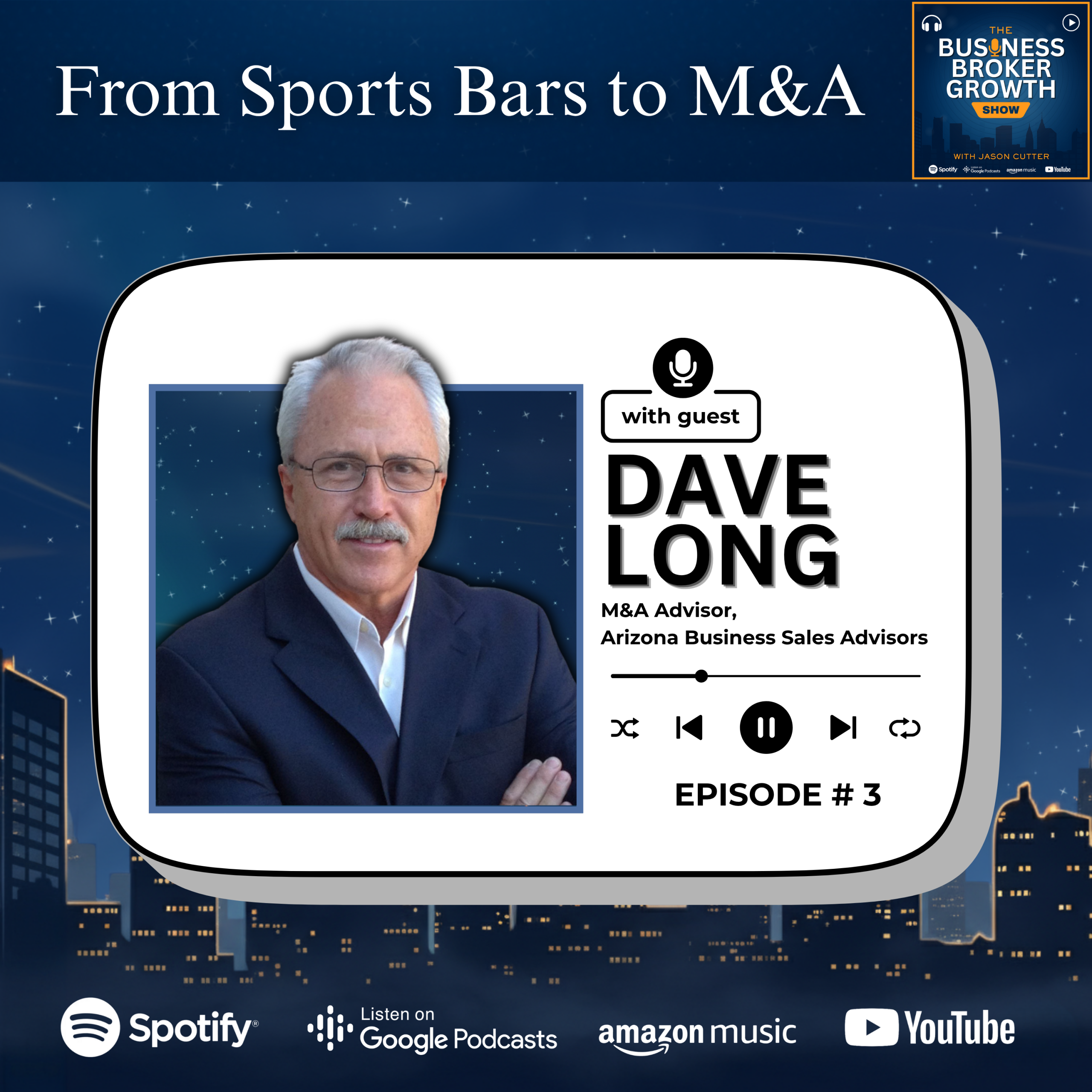
In this episode, Jason Cutter sits down with Dave Long, M&A Advisor at Arizona Business Sales Advisors, to reveal what truly drives sustainable growth.
Dave shares lessons from transitioning to a solo brokerage, selecting energy-aligned clients, and pursuing continuous education to stay ahead.
Ready to move from chasing deals to building a business you’re proud of?
Subscribe for more candid insights to help you engineer your pipeline and become a trusted advisor.
LinkedIn: https://www.linkedin.com/in/davelongaz
Email: [email protected]
Website: https://arizonabizsales.com/
Jason Cutter [00:00:02]:
I have Dave Long. He is a M&A advisor at Arizona Business Sales Advisors. Dave, welcome to the Business Broker Growth show.
Dave Long [00:00:18]:
Thank you for that warm greeting and it’s nice to be here.
Jason Cutter [00:00:21]:
And we’ll get into your background, we’ll get into your story. We’re going to have a lot of topics today, but for the audience especially because we’re starting the show, it’s the first season I want to share. Our mission is to equip brokers with modern marketing systems that replace guesswork with growth, empowering them to be trusted advisors for owners and partners. And as brokers grow, so do the business owners they represent, creating better exits, stronger communities and more rewarding futures. And so glad that you’re here as an audience. So glad that you’re here with us, Dave, for the show today, we’re going to talk about your background. We’re going to go through a rapid fire growth playbook segment. Hopefully you have some tips lined up.
Jason Cutter [00:01:04]:
Three to five marketing tips to help brokers out there. We’re going to talk about the one that got away, the lessons of a, of a challenging transaction that might not have gone through, that deal that didn’t close, what you learned from it. And then we’re going to finish up talking about the future of business brokers, M and A media intermediaries. And for the audience out there, as you listen to this, take some notes, make sure to pick up any nuggets that Dave drops and shares with all of his experience. Don’t make this just something you’re listening to. It’s casual, it’s fun. Like actually look for the value, look for the things that will help you. I know that Dave has a lot in the conversation we’ve had.
Jason Cutter [00:01:40]:
Our calls have, have gone over each time because there’s so much going on. And so let’s talk about this. Dave, you’re on the show here, season one. Let’s talk about it. So in your background, I know that you started in Kansas City, you started with sports bars as an owner, you did a lot of different business things. You ended up in Arizona and then you got into a Sun Belt franchise. You had brokers that worked for you. You owned a flower shop.
Jason Cutter [00:02:07]:
Then you decided to become a solo business broker. You know, one person, shop, share more about that journey. Kind of the highlights of, of all of that and how you got to here.
Dave Long [00:02:19]:
Yeah, sure. Well, yeah, it was in the Kansas City area. We were in the restaurant business. We owned a couple of sports bars and grills and a flower shop. And in 1999, we decided to move to Arizona. And we did. We sold everything, moved to Arizona. We were looking for something to do.
Dave Long [00:02:40]:
We went to a local. I wasn’t even aware that such things existed, these business brokerage franchises. But we found a local business brokerage office, and they had a flower shop for sale, and we bought that flower shop, and now it was my turn. I was looking for something to do. They didn’t really have anything. I wanted to stay away from, you know, the restaurant and the bar business. They did have some of those for sale. They didn’t appeal to me.
Dave Long [00:03:09]:
The industry didn’t appeal to me anymore. I’ve been doing it for 25 years. So I just started a conversation with the owner of that office. I ended up buying the office from him. And then this would have been in the early 2000s. We had several brokers working for us, and it was fun and exciting. In the beginning, I was learning a new industry, the things that I was really interested in. And I just did not like managing adult brokers.
Dave Long [00:03:43]:
Managing adult people in that business, it took. Not because I don’t like people, but it took me away from doing deals. And I like doing deals. I like getting involved in the projects and finding out about my clients and their backgrounds and how their business runs and, you know, what drives margin, what drives profit, and what works. What didn’t work, I get interested in. So I find myself managing a bunch of brokers in the office and not really having a good time. So this would have taken us to the Great Recession. 2010, 2011, 2012.
Dave Long [00:04:16]:
We kind of wound down that office, and my wife and I moved down to the Valley, where we launched Arizona Business Sales Advisors. And we’ve been busy at that since then with a couple of little projects here and there. We had a project in Oregon that took me away for four years as a general partner operating that. But I was still doing the advisory and M and A work in between. So, yeah.
Jason Cutter [00:04:48]:
It’S interesting because I hear you talking about it. I know you shared with me before about managing other brokers and that whole thing. And then, you know, wanted to get away from that, essentially away from that is as I hear you talk about it. I wonder how many, you know, brokerage owners feel that same thing. And they get separated from the deals. They can kind of live vicariously through their brokers for their transactions, but then maybe it ends up more babysitting than deal making and they’re missing that piece that got them into business. That’s what it sounds like that you.
Dave Long [00:05:26]:
That’s exactly what I went through. That was a good description of exactly what happened to me. And there are offices here in town. I spent a little time working with one of those. I won’t mention their name, but They’ve got about 30 brokers working in the office. It’s predominantly a real estate company with a commercial division, a residential real estate division, and then a business brokerage division. And, you know, that is set up to supervise agents and brokers. There may be a thousand agents and brokers that work in that office, and about 30 are doing business transactions.
Dave Long [00:06:03]:
They’re set up for them. I’m a small business guy, and I wasn’t set up for that. So at some level, that model works, and I get it. But I wanted to do deals, and now I get to do deals, so everything is happier now.
Jason Cutter [00:06:22]:
Yeah, it’s interesting. Total side note unplanned. But there’s a book called Company of One which really advocates for the solopreneur business. Right. In the book, he really says, if you’re a solo person in his example, and you’re making three to $400,000 a year and you really have no employees, you don’t have much overhead, then that’s. That’s really great economically. Right. Especially relative to the rest of the country and the rest of the world.
Jason Cutter [00:06:49]:
And. And for a lot of people to fight that peer pressure, internal pressure, some kind of voice saying, I need to have a big office, I need to have a big company. I need to start the next Facebook, I need to, you know, whatever, versus. Could you just be happy by yourself?
Dave Long [00:07:04]:
Right.
Jason Cutter [00:07:04]:
Not advocating for, against, but yeah, it’s interesting, especially for people listening to this, thinking like, oh, I need. Like, you don’t always have to do more. Have more of a team. Right. I like how you’ve kind of realized that and then said, okay, now this is what I’m happy with.
Dave Long [00:07:19]:
Yeah, Two things come to mind there if. If you’re kind of running an office and you desire that commission sharing, that fee sharing. So as an office owner, you provide a nice office and these systems and procedures and sops in place for your agent brokers, but you’re getting a piece of what they’re bringing in, and if that piece is important to your business model. I know some brokerages that are pulling away 25 to 30% of the agent’s fee that he brings into the house for all of those things that they offer, the supporting systems that they offer him. So if that is Important to their model to keep that thing going. That’s fine. I’m, I’m to the point and I have been for several years where I’m way beyond that. And in the six figures, very comfortably, I don’t have to trade managing adult people so I can get a piece of their fee to do what I do.
Dave Long [00:08:26]:
And at the same time I get the benefit of avoiding those things I don’t like.
Jason Cutter [00:08:32]:
Yeah, and I love that self awareness of what you know you like and don’t like it. And there’s different modes for everybody, which I think is what’s great both about the brokerage world that you’re in, but just in life in general. So let’s talk about another topic I know that you and I chatted about and I’ve seen this even before we connect. It is that it feels like there’s a lot of people who have piled into business brokerage. Right. The barrier of entry to be a business broker or call yourself business broker is pretty low. Short of like buying into a franchise of something, you know, that’s somewhat of a cost. But even so, like people who are coming from other sales related industries.
Jason Cutter [00:09:11]:
You’ve mentioned residential real estate. I’ve seen commercial real estate. They think, hey, it’s like real estate. Like I’ll just get into business brokerage because I like business whether they’ve owned one or not. What are your thoughts on that? What do you see that in, in, in your world?
Dave Long [00:09:26]:
Yeah, well, there are several states that regulate, I think maybe 30, 35, maybe even more states that regulate what, you know, we do in each individual state. That’s certainly the case in Arizona. Here it’s not unique. The department of Real Estate manages the business brokerage industry and community. So if I want to collect a fee by representing somebody selling a business, I have to have a real estate license here. So I think that’s kind of the situation that drove a lot of X or former real estate agents and brokers into my industry because we had to go get a real estate license. And literally, I mean, it’s still somewhat unfortunate because somebody new into this industry in Arizona, he’s got to go take a 40 hour real estate class, right. And learn about nothing that we do.
Jason Cutter [00:10:26]:
Right.
Dave Long [00:10:27]:
He will take 40 hours and then for sit for a fairly intensive exam and he will now know almost nothing about residential and commercial real estate and he will know nothing about M and A or business brokerage. So now he’s got a license and now he thinks that, wow, I can choose residential real estate Commercial real estate, or I can be a business broker. And that’s a very dangerous situation to be in. Kudos to the Arizona Department of Real Estate, who recognized maybe 15, 20 years ago that the industry has specialties and you should not represent clients for a fee outside your specialty. And I think the stricter, more defined real estate regulation is you cannot represent somebody outside your specialization unless you disclose to them that you aren’t specialized in what they’re asking you to represent, and then you can go ahead and represent them. So it’s ironic, and it’s kind of a dangerous situation. But to my point, when we started this, I think that’s how a lot of residential agents and brokers kind of piled into the business brokerage arena early on, late 90s, early 2000s. So there’s a lot of folks who were former commercial and residential real estate agents in the industry.
Dave Long [00:11:59]:
And I think, although we all have to have that license, some of us, like myself, would never dream about representing somebody selling their house. I, I don’t know anything about that other than my experience of buying and selling my own properties. And I know nothing about representing clients in the commercial real estate business. So that’s kind of the flip side of that coin. Yeah, you may have the license, but, man, don’t, don’t step off into that quagmire because you’re going to get in trouble real quick.
Jason Cutter [00:12:34]:
Well, and I think that’s the challenge, right, Is that, let’s say, for real estate agents, I know a lot of them who are like, well, I like going to look at houses, and I’ve bought a house before or had an agent help me sell a house, and it seems easy, so I’ll just do it right? And I have had an active real estate license when I lived in Washington State. The course is really easy. The test for me was really easy. And none of it prepared me to actually be able to help somebody buy or sell a house. Right? Then it just comes experience. You got to know everything. Like, it’s so surface level doesn’t prepare you. And I feel what you’re saying a lot, which is in the business world, you know, people who may not have even ran a business or owned a business getting into business brokerage, they don’t even know what it’s like for their clients, let alone the experience of, you know, the transactions.
Jason Cutter [00:13:23]:
And it’s tough because there’s only one way to get that experience is probably go through transactions, but at what cost?
Dave Long [00:13:28]:
Yeah, yeah, go do deals.
Jason Cutter [00:13:30]:
Go, go do deals. Which then goes to the next part, right. Which I know is, is a hot topic, which is valuations, where, you know, what do you want to. What do you think your business worth? Okay, great, we’ll sell it for that. Or they don’t know how to evaluate a business. And where do you see that just really wreaking havoc, let’s say for either the market, the industry and, or you know, sellers who are, guess picking. Picking the wrong broker.
Dave Long [00:13:59]:
Yeah, I. Two things come to mind. I’ll use us as an example. I know of offices here in Arizona. They are business brokerage offices and they, they, the owners don’t really get too caught up in valuation. They believe that the market will work out the price, therefore they don’t get too caught up in value. I’ve talked to these folks. I know brokers who work in that environment and they have quotas placed on.
Dave Long [00:14:42]:
So here you’ve got a man or a woman who got to call themselves a business broker. They’re told in the beginning, if you don’t have five client engagements every month, and if you don’t bring in one new client, this is another leftover from the real estate industry, one new listing. If you don’t bring in one new listing a month and you don’t talk, you’re going to have five meetings a month. You’re not going to be able to work here. You’re not going to last. So here’s this pressure from bringing in deals and you don’t really have time to spend the time that’s required and needed and the time that’s required to get the education to learn about this valuation process and all the intricacies of doing it correctly. You don’t have time because you’ve got these sales quotas that are always hanging over you. And in some cases this particular office, they’re like, just list it for whatever the client wants to list it for.
Dave Long [00:15:49]:
Don’t get too caught up in the valuation. If he wants a million and you think it’s worth half of that, don’t worry about it. The market will work it out. And of course, that is a direct reason why the industry has a 70, 80% failure rate. Because all these businesses go on the market, nobody did proper valuation work. And they can’t defend the price, they can’t defend what they’re asking for. They can’t take a roadmap of how we got to the number and kind of prove how we came up with that number. They can’t defend the asking price.
Dave Long [00:16:30]:
So that’s what I think leads to the high failure rate in the industry. And it’s kind of the opposite of what I’ve been doing for a long time. But I’m kind of a numbers and spreadsheet and kind of an analysis kind of guy. That’s what I like doing. It probably makes me really boring in some circles. And my wife sometimes scratches her head and goes, I have no idea what you’re doing, but I can defend the price. Right. And that’s kind of what leads to a higher success rate, in my opinion.
Jason Cutter [00:17:03]:
Well, if it helps, I’ve got a shirt that you could get. My wife got it for me. It says, I am secretly, secretly creating spreadsheets in my mind. I’m thinking about things in numbers and business. And, you know, I think it’s might not make you as fun at parties as others, but I think the key is that, you know, it helps. And I think those valuations are important. I mean, you know, nothing worse than somebody thinking they could sell something and then the market will tell you what it’s worth. But the problem is that throwing spaghetti at the wall mode of, you know, hoping that it would.
Jason Cutter [00:17:39]:
So.
Dave Long [00:17:41]:
All right, so I was, I would point out this real quick that, you know, there’s, there can be a distinct difference between value and price. I think everybody gets that. You know, you can use the residential real estate model. The seller of a house thinks it’s worth, you know, 5 million and you can show them all day long how homes just like this have sold for half that. And then you as the advisor and broker can decide if you want to walk away from that, if the seller is not going to be reasonable with the price. And understand you’ve got a professional opinion built on many, many years and a lot of education. If he’s going to ignore that, I mean, do you really want to work together anyway? Maybe that’s not a good fit and maybe that is very likely going to lead to that 80% failure rate. And why do you want to spend all hundreds and hundreds of hours in this process with that person, with that business when you know where it’s going to end up?
Jason Cutter [00:18:46]:
Yeah, yeah. It’s not worth it. Right. And the thought, and I can see this with new brokers or inexperienced ones thinking, well, as long as they have the pipeline, as long as I have the listings, it’s going to work out. But there’s a lot of effort, there’s time and money into that, which, you know, isn’t, isn’t a good deal long term because you’re, you’re planting really bad seeds in the ground that are never going to grow, but you’re, you’re banking on those and it’s just, it’s, it’s never going to happen. So let’s get into the rapid fire, the business broker growth playbook section. So this is where, and I prepped you in advance, would love to hear some ideas like 3 to 5 kind of rapid fire tips of growth hacks. Things you’ve done because you’ve been a, you were buying and selling businesses before you realized it was actually an industry because you were doing it for yourself and just in, in the transaction mode of doing those things before this, have a lot of experience both in the franchise broker world and then, you know, being in that kind of mode and then the solo.
Jason Cutter [00:19:52]:
And I know that for you, what, you know, we shared, what we talked about was that, you know that a lot of business owners are just getting bombarded just daily by emails, by cold, cold calls, by all the things that happen. I talked to a broker the other day and he knows of a company that will help a broker send 10,000 emails a month. Right? And just scorched earth, just, just doing everything they can. And so how do you actually grow your product line? How, what, what have you found works? What are your like quick tips? So let’ that’s number one. What’s the, what’s the, what’s the number one on your list? In, in, in order or not in order?
Dave Long [00:20:33]:
Yeah, yeah, in no particular order. I think the most important one for me and this is something that I, I had to learn over time. Every time you sit in front of a potential client, you do the valuation, you pitch the price or you pitch the value, pay particular attention to the energy between the two of you. You’re not going to see eye to eye or even get along with some potential clients. And man, if you don’t have that energy, you’re going to work together for a long time and you’re going to be in situations that present a lot of pressure, you know, offers and negotiations and you know, you’re going to report your progress to your client and there’s just going to be a lot of pressure situations. And if, you know, if you detect in the beginning that it’s just not a fit, walk away. And that’s hard because, you know, a lot of people that are in the industry again, they’ve got the quota, they’ve got their ego that’s going, man, I’ve got to get this one in house, I’ve got to land this one. It’s a nice one.
Dave Long [00:21:46]:
And I’m telling you, learn how to just say thank you, but this is just not a good fit for me. Not a good fit for us. The second thing that I would probably say, if you have not done the educational piece, if you haven’t taken the classes, if you haven’t joined the trade organizations and there are several, do that from day one, start taking classes. Almost all of the organizations, Amna, IBA, M&A Source, they’re all offering online classes sometimes. Some are offering online certifications now. You know, many years ago you had to travel to an annual or semiannual conference and take classes. Now you can take those online. Just take the classes, get the education.
Dave Long [00:22:41]:
So you may not have the experience doing the deals, but you’ve got that background, you’ve got that education, you learn some things and you can apply those, you know, from day one.
Jason Cutter [00:22:56]:
God, that’s great. Do you have a third? Do you have more?
Dave Long [00:23:02]:
I did when I started talking, but I don’t. The third one is not coming up, but it will strike me here when we’re about five minutes down the road.
Jason Cutter [00:23:13]:
So, so we’ve got the, the two that you mentioned. One is the energy between the two of you. The second one is the education piece. The trade organization, you know, being a part of things like IBA taking the classes. I think number one is, is very fascinating because it takes an abundance mindset instead of a scarcity mindset. And it takes recognizing and realizing that sales, anything to do with sales persuasion is all about relationships. It’s all about human to human. It’s all about like anything.
Jason Cutter [00:23:42]:
Everything in life is sales, which is what I’ve said for years from a sales aspect. And so it’s like anything, like if the relationship doesn’t start out well in the beginning, it’s not going to get better. And in your world in particular as a business broker intermediary is if no matter what, it’s going to have tough times, like a long term relationship in life, like life is going to punch that transaction in the face several times no matter what. There will be challenging moments and like you said, if the energy’s not there, it’s not the right fit, it’s not the right match. How are you going to handle the tough times and weather through to get the ultimate result? Yeah.
Dave Long [00:24:25]:
And that something you just said reminded me of the third, the number three. And that is never forget who you represent.
Jason Cutter [00:24:33]:
Right.
Dave Long [00:24:34]:
So you represent the client, you’re acting in his best interests. And sometimes, you know, when there’s a fee involved. And you’ve got hundreds and hundreds of hours and months and months invested in it. And I’ll use a specific example. You get a full price offer on a nice business, let’s call it a $15 million price. You get a full price offer, you present it to your client, and he doesn’t like the buyer. He doesn’t think that buyer is a good fit for his company. And you need to remember who you represent, why you’re in that transaction.
Dave Long [00:25:19]:
He’s got a legacy to protect. He’s got employees to protect. He’s got a company that he wants to see go on and on, taking to the next level. And if he doesn’t think this buyer is the right buyer, that is his unilateral decision and his right to make. And this particular example that I’m kind of thinking about right now was at 15 million. And we turned down two full price offers before we got to the third. There was a half a million dollars less for who my client determined was the right buyer. And that was the right decision for him.
Dave Long [00:25:59]:
It was the right decision for me. And we got that deal done. Sometimes it’s tough though, you know, when you’re going, what this is, this is a perfect. It’s a full price offer. What are you talking about? And you just have to remember who you represent.
Jason Cutter [00:26:14]:
Yeah, I love it. I think that’s great. So energy between the two of you, education, never forget who you work for. I would ask, which one of those would you pick and bet money on being the number one thing? I’m going to assume it’s remembering who you work for out of everything.
Dave Long [00:26:33]:
It is. You’re correct.
Jason Cutter [00:26:34]:
Yeah. All right. That was easy. All right, so let’s get into the next segment here. This is, we could call this the one that got away. Lessons from the lost deal. Every broker, every advisor, every owner, salesperson, everybody has one of those where maybe there’s definitely lessons to learn from the experience of it, no matter how painful, especially in your world, like emotionally, financially, the time that’s spent. We’re talking long transactions, things like that.
Jason Cutter [00:27:05]:
I know it’s sometimes tough to share. Don’t always want to talk about. I know we talked in advance and so let’s talk about for you with whatever details you want to share. It doesn’t have to be a lot of specifics, but let’s talk about what was the, what was the deal that got away from you that, that lost deal?
Dave Long [00:27:24]:
Well, this one is particularly frustrating because it was outside my control and outside the client’s control. And there was no. After we discovered the problem, and I’ll get into it in a second, you know, we attempted to fix the problem, and then we realized that, you know, the water’s already out of the bottle and what do we do now? So I think it’s important for me to say in the valuation process, sometimes I work with a client for six months, nine months, I’ll. I’ll take a look, we’ll gather all the materials we need to do our work, and we will find them that process. This is another benefit to going through this. You’ll find things that may be broken or things that may be wrong or things that need to be fixed or even improved upon in terms of just their books and records. Maybe it’s a simple reporting thing. If we pull in some data on the industry and we realize we’re comparing our client to his peer group and we see something that’s totally off, we may see that he’s reporting something in cost of goods that his entire industry does not.
Dave Long [00:28:39]:
And we make a suggestion that, you know, a buyer at this level is going to be pretty sophisticated. They’re going to look at this and they’re going to want to know, you want a premium for the business, yet you’re not performing as well on the gross margin line with your peer group. Well, we may suggest that he moves something around, you know, just drop it below the margin or it up in cogs, you know, where your peer group reports it. So it can be many things like that. And this particular example, we got that work done. This was an inventory issue where there was no annual physical inventory. And they had. They’ve got a lot of inventory and a lot of inventory turned.
Dave Long [00:29:25]:
And I advocated for them to do, if not a physical inventory quarterly, to do something close to that, something that they could defend internally, defend in their minds so that they didn’t have these crazy swings in cost of goods during the year. And then at the end of the year, they reported and there was this wild change in cost of goods in the margin. So we agreed that we were going to do periodic reporting during their fiscal year. And so we talked to cpa, got that all fixed, you know, from an SOP and procedure standpoint. And they started with the year end, and then we proceeded into that, you know, first year with the quarterlies. And we realized after we had gone to market that that adjustment was not correct. And it had a massive effect on their ebitda. And it wasn’t an increase.
Dave Long [00:30:34]:
It’s never an increase in ebitda. When there’s a problem, it’s a decrease. And so, you know, everybody, you know, the natural instinct initially is to point fingers. You know, we had to yank the business off the market, lost time, downtime, really frustrated my client, very upset. I get it. I would be too. And we literally, you know, had to, you know, stay off the market for months until we got this settled down, got it figured out, and then re enter the market at a lower price. So it was a very unfortunate situation.
Dave Long [00:31:17]:
Nobody’s at fault. We tried to make some improvements, but nobody’s perfect. And you know, a mistake was made. But the good ending is that we got it fixed and that business is back on the market and everybody is playing nice together and seems to be happy.
Jason Cutter [00:31:40]:
So if, if you could go back and redo something, anything, is there anything in there that you would change or would have changed throughout the, let’s say the initial process? It sounds like when you’re doing the review and evaluation.
Dave Long [00:31:58]:
Well, the review and the valuation is how we identified the problem, you know, because of the inconsistencies and their cost of goods and therefore their margin. That’s what led to us identifying that as a problem and then setting some procedures and I think kind of advising my client on at least this is the result that we want. This is your business. I don’t understand all the accuracies of how you report web sales and how that, that’s basically manual entry into QuickBooks Online. QuickBooks Online is probably not the perfect solution from an accounting standpoint for a company their size with all the details that are going on. So I think we probably would have maybe paused a little bit and really discussed what that new procedure is, what that new SOP is. It’s difficult to do a physical inventory on a quarterly basis with, you know, 80,000 parts. You know, it’s nearly impossible.
Dave Long [00:33:14]:
So we probably could have decided to back off a little bit in terms of taking it to market and let us work some other partners and figure out what a kind of a long term accounting situation is to get that fixed and buttoned up. Everybody did their best and everybody agreed that the process we came up with was a good one. You know, it didn’t, it didn’t work out. But in the end, I think we’re going to be just fine. It’s a really a great business. Great books and records now, no inconsistencies. And we’re going to get a nice multiple and a nice number for that for our clients.
Jason Cutter [00:33:56]:
So lost deal in the Moment, a lot of readjusting, bringing it back. So not a total loss deal yet because it’s back on as of when we’re recording this. So there’s, there’s, there’s definitely. I won’t even say hope looks, looks good, promising future on that. Every, I do know that every loss deal, I mean, the, the way that you learn in life is usually by mistakes and short term failures. If you learn from them and then, you know, that’s the only way to go. Kind of going back to what we talked about with licensing and experience. Like, the only way you can get the experience is to do it.
Jason Cutter [00:34:30]:
It’s tough to do it without the experience. You just kind of get through it. Hopefully you have a good mentor and a guide and someone helping you from this transaction. What’s the one or two sentence, sentence lesson that you give to other brokers so that they don’t make this kind of, you know, I won’t even say mistake, but, you know, step on this kind of a landmine, let’s say.
Dave Long [00:34:53]:
Yeah, well, it’s back to remember who you represent and take your time. And if you’ve got to pull it off the market, pull it off the market. Yeah. This is not about you. You represent them. This is a life decision for them. If we’ve got to pull it and put it back on later, do it and just go slow. When you identify a problem, make sure you thoroughly discuss that, make sure you thoroughly understand it and make sure everybody agrees on the solution.
Dave Long [00:35:32]:
And sometimes that, listen, we’ve closed a multimillion dollar business literally from the time we engaged with the client in a contract and closed that in four months. And others, we got it done in 24 months. So each one’s got its own unique timeline. And if something pops up, surprises pop up. You represent them and you do what’s right for them.
Jason Cutter [00:36:04]:
I love that advice. Going back to what you said, represent the client. And I love that other part is like, take it slow, take your time. You know, it’s better to do it right once, you know, like the, the old cliche axiom, I think, is that what it is. If you don’t have time to do it right the first time, how are you gonna have time to do it a second time? Right. In this case here, slow is. Slow is good, especially in the world that you guys are playing in. So before we get to your final thoughts and then the ways that the audience can reach out to you, find out more about what you do, kind of check in on what you’ve got going on.
Jason Cutter [00:36:41]:
I want to remind everyone here, listening in, tuning in, especially in season one about business broker growth. So our mission is simple. Like I said earlier, equip brokers with modern marketing systems that replace guest work with growth. And we know that brokers are great once they get into the room. I talked to so many brokers where they, once they get into a room they’re good, they know what to do. Kind of like yourself Dave. It’s they, they, they’ve got that part, they just need help getting into more rooms. And this is where we come in with our coaching, our advising and even our done for you program because we know that brokers are busy, they’re trying to do what they do best and that’s where we come in to help.
Jason Cutter [00:37:17]:
So Dave, if you could give brokers one piece of advice on winning more listings and or referrals, you could go either way of that on the referral partner side or new listings with businesses, you know, what would that be?
Dave Long [00:37:35]:
Well it’s hard for me to give just one but I would say that if you work for a big office that may not be enough to get to get you in the door. And I know this really well being a one man office for the last basically 12, 13, 14 years. If you’re not doing consistent, continuing non stop marketing and it’s multifaceted in this day and age it used to be about SEO and search engine traffic and website traffic. If you’re not all over the place, if you’re not doing the SEO piece, you’ve got the website that’s working for you at performing, you’re monitoring that performance, you’re doing some Facebook, some LinkedIn, all the social media channels and you’re doing things like this, you know, recording some video and you’re blogging, writing a lot of articles. The only way you’re going to punch through specifically in the Arizona market is if you are top of mind to a business seller or a business owner where he keeps looking around and there you are again. Maybe you know, he’s getting a referral from his team, a cpa, a lawyer, an accountant, somebody on his team says yeah, don’t you need to talk to Dave Long? And he’d go I see his LinkedIn articles or I see his blog post and then there was a website. Unless you get to that point by staying out there consistently, you’re not going to punch through, you’re not going to get the opportunity to get in the room. That’s the first piece and then the second piece Is do the work, learn how to do the work.
Dave Long [00:39:24]:
In many of these bigger offices, they’ve got some valuation software in house. There’s a lot of stuff out there. We developed our own internally trial and error. But there’s stuff you can make it very easy, learn how to use that, spend the time and work for somebody who doesn’t put quotas on you.
Jason Cutter [00:39:44]:
I love it. I think that’s great and I appreciate that obviously, because it is a noisy world. The Internet has made it so that you can get all the information you need or want now at the, at the press of some buttons. Especially if we look at the, the baby boomer type demographic that didn’t grow up with this. We didn’t grow up with this. This is a new thing. But now everyone’s just used to being able to find anything and everything they want. You’d think it would make it easier.
Jason Cutter [00:40:10]:
It actually makes it harder because now there’s unlimited choice. So how do you pick who to, to work with? Especially when you’re, you know, transferring your legacy and, and maybe cashing out on something you’ve, you’ve spent a long time growing. And I love that point about, you know, making sure that you’re everywhere with proper quality content. It’s, it’s both a quantity and a quality in order to have that out there. So for people who want to connect with you, maybe they want to talk to you about some deals, maybe they have some opportunities, things like that. All this will be in the show notes. But if you in the audience want to connect with Dave, you can find Dave Long on LinkedIn. It’s Davelong AZ if you’re typing it in.
Jason Cutter [00:40:48]:
The business company website is Arizona Business Sales Advisors is Arizona Biz Sales biz sales.com and you can email Dave at dave.longabiz sales.com Again, all of those will be in the show notes. Dave, so glad that you’re here today. Thank you for sharing all this.
Dave Long [00:41:07]:
Thank you.
Jason Cutter [00:41:07]:
Vulnerable in so many different ways and being on this first season and really just giving back to other brokers out there and sharing because this is more of that than bizarre biz dev for you. This is more of just sharing that wisdom. So I appreciate you for giving so much today.
Dave Long [00:41:25]:
Thank you. And I’m glad our paths crossed. This has been a lot of fun and I’m sure we’re going to do another one of these real soon.
Jason Cutter [00:41:32]:
Yeah, it’d be great. And for everyone tuning in, make sure you follow business broker growth on LinkedIn. Subscribe to the Business Broker Growth YouTube channel. You can go to businessbrokergrowth.com to find out more. Got ebooks, we’ve got guides, all kinds of things on there. We appreciate you turn tuning into the Business Broker Growth show where we help brokers build modern marketing systems that replace guesswork with growth. Hope it will help your business in small and big ways. Thanks to Dave for his tips.
Jason Cutter [00:42:03]:
And until next time, stop hoping for deals. Start growing your pipeline.
What can business brokers do to stay ahead in a rapidly evolving industry? And how should they balance new technologies like AI with the...
What will brokers need to stay relevant by 2030? And if you could wave a magic wand to automate just one marketing strategy, which...
Are you still relying on luck and outdated tactics to win listings, or are you intentionally building the kind of trust that makes business...